
Key Takeaways
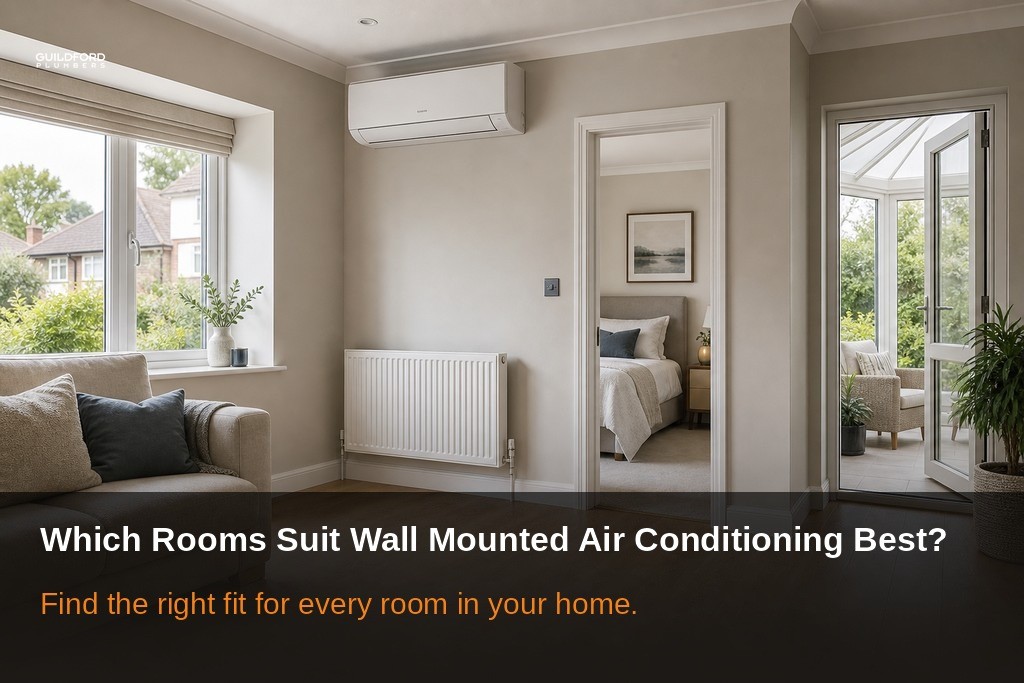
Wall mounted air conditioning works best in bedrooms, living rooms, conservatories, and loft rooms when you match unit size and placement to how each room is actually used.
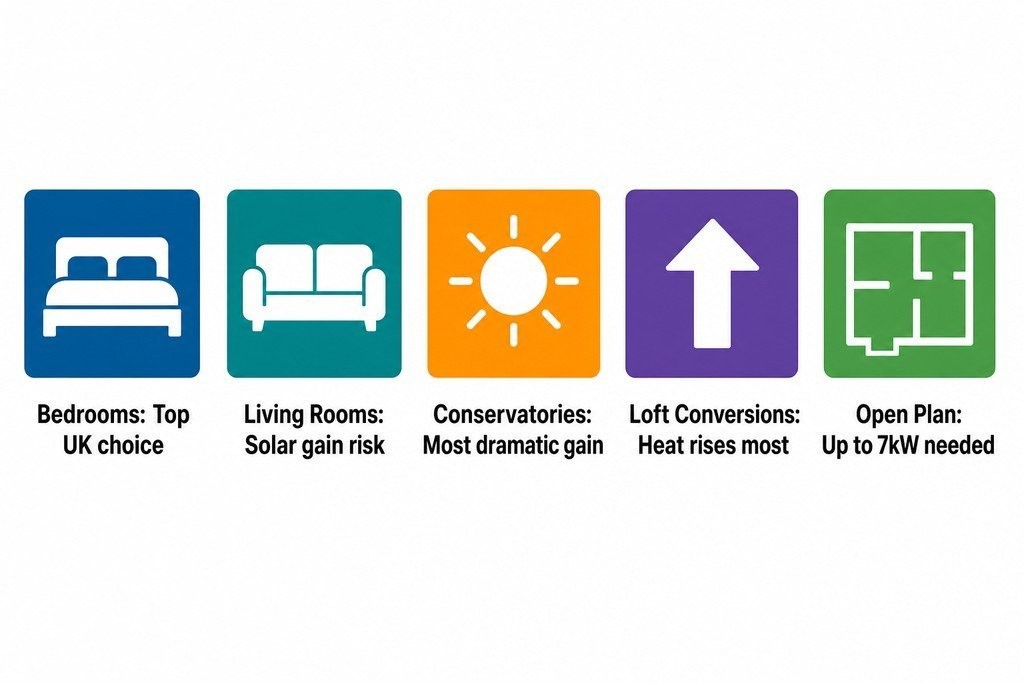
- Bedrooms are the most popular choice for wall mounted air conditioning because stable overnight temperatures above 18°C disrupt sleep, and a split system keeps things quiet by moving the compressor outside.
- Living rooms with south facing windows and large glazed areas benefit greatly from wall mounted units, but accurate sizing is essential to handle solar heat gain and any open connections to adjoining spaces.
- Conservatories are the rooms that see the biggest improvement from air conditioning, though their structure and glazing type mean an in person assessment is strongly advisable before choosing a unit.
- Loft rooms trap heat more than any other part of the house, so units should be sized slightly above what a standard calculation suggests, and pipework routes need to be planned carefully during a conversion.
- Before installation, check that your wall can take the fixings, that there is a clear pipework route to an exterior wall, and that your property type does not require planning permission or landlord consent.
Choosing the right rooms for wall mounted air conditioning is one of the first decisions you will face once you have decided to move beyond a portable fan or a temporary fix for summer heat. It is not simply a case of picking the hottest room in your house. The right choice depends on how the room is used, how it is built, and what you realistically expect the unit to do throughout the year. Get this right from the start and your investment pays back in comfort every single day.
This article sits within a broader wall mounted air conditioner guide covering everything from choosing the right unit to understanding running costs. Here, the focus is entirely on room suitability so you can walk into any conversation with an installer already knowing what you want and why. If you are also weighing up the advantages and disadvantages of these systems, the wall mounted air conditioner pros and cons are covered separately in a dedicated piece.
Which Room Is Best for a Wall Mounted Air Conditioner?
Fewer than 5% of UK properties currently have air conditioning installed, according to a figure cited by Absolute Climate Solutions. That is changing quickly as UK summers grow warmer. The 2022 heatwave pushed temperatures beyond 40°C for the first time on record, and homeowners across Guildford and the wider Surrey area are increasingly looking for a reliable solution. Older Victorian and Edwardian terraces, which make up a significant share of the local housing stock, can be particularly difficult to keep cool in summer. A wall-mounted split system offers consistent, controllable comfort that works in both directions, cooling in summer and supplementing heating in winter.
The indoor unit circulates conditioned air while the outdoor unit handles heat transfer, keeping compressor noise outside the living space entirely. This is why wall-mounted systems are considerably quieter and more effective than portable alternatives. A typical installation requires a wall penetration for pipework, access to an external wall for the outdoor unit, and a suitable electrical connection. All of these require proper planning and a qualified installer.

Bedrooms: The Most Popular Choice for Guildford Homeowners
Bedrooms are consistently the top choice for UK homeowners, and for good reason. Sleep quality drops noticeably when bedroom temperatures stay above 18°C overnight, a threshold regularly crossed during a warm Surrey summer. A wall-mounted unit keeps the room at a stable temperature without the background noise that makes a portable unit so disruptive at 2am.
According to Heatable, portable air conditioners generate between 50 and 65dB of noise because the compressor sits inside the room. Wall-mounted split systems move that compressor outside, and many modern models run at noticeably lower noise levels indoors.
Where to Position a Bedroom Unit
Positioning matters considerably. Mount the indoor unit on a wall that allows airflow to circulate across the room without directing cold air straight onto the bed. A high position on a wall opposite or adjacent to the bed, angled slightly away from the sleeping area, tends to work well. For a typical Guildford double bedroom, a 3.5kW unit is widely regarded as a reasonable starting point, though a proper heat load calculation should always inform the final decision. Ceiling height, window size, and the direction the room faces all affect how much output you actually need.
What About Smaller Bedrooms?
Single rooms and box rooms need careful thought. Space is limited, walls are often shared, and quiet operation is just as important as in a larger room. A compact unit rated around 2kW to 2.5kW is usually sufficient and avoids overcooling a small space. Prioritise a clear wall that lets airflow reach the centre of the room without blowing directly across the pillow. A high side wall or the wall facing the door are both worth discussing with your installer, as pipework routing to an external wall will also influence the best position.
| Bedroom Type | Suggested Unit Output | Key Positioning Consideration |
|---|---|---|
| Standard double bedroom | Around 3.5kW | Mount opposite or adjacent to bed, angled away from sleeping area |
| Single or box room | Around 2kW to 2.5kW | High side wall or wall facing the door; avoid blowing directly across the pillow |
Living Rooms: Balancing Comfort and Appearance
The living room presents a different challenge. Comfort matters, but so does how the unit looks in the space. Modern wall-mounted units have improved considerably in terms of design. Slimline, white or neutral-toned models sit discreetly on a high wall without dominating the room. Position the unit so that conditioned air reaches the occupied area, which typically means avoiding placement directly above a sofa or television.
South-facing living rooms with large windows benefit most from air conditioning but also place the greatest demand on it. Direct solar gain can overwhelm a slightly undersized unit, so accurate sizing is important. Many homes in areas such as Merrow, Burpham, and Shalford feature extended rear living spaces or open-plan ground floors where this is a particular consideration. If your living room opens into a hallway or kitchen, some cooled air will migrate into adjacent spaces, and this needs to be factored into the capacity calculation. A good installer will assess the room in person rather than simply quoting a standard size.
Conservatories: Where the Difference Is Most Dramatic
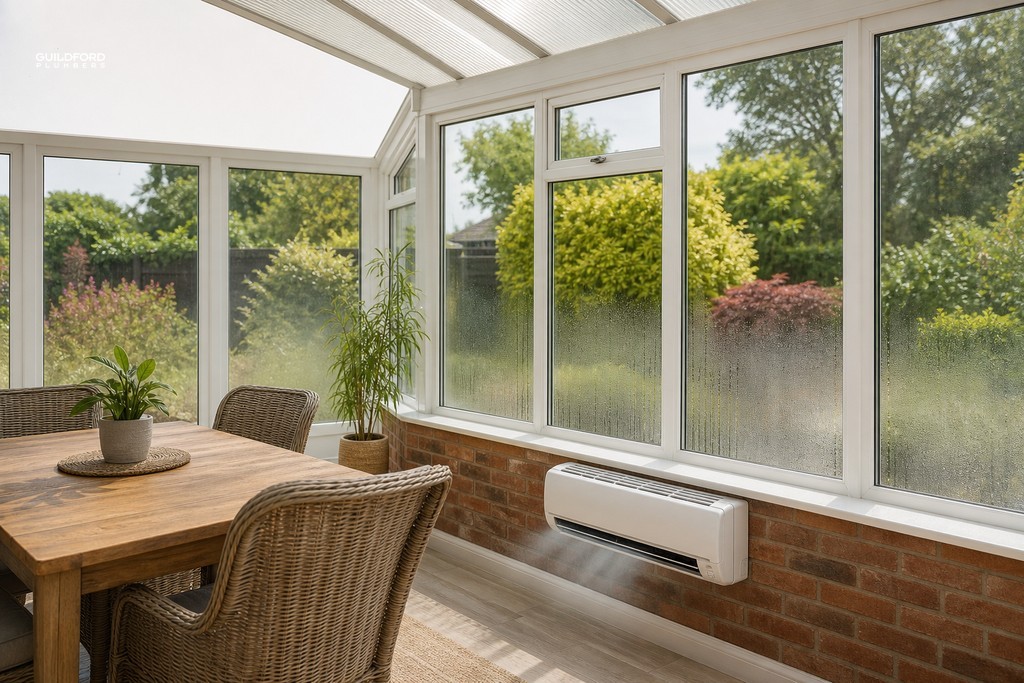
If there is one room where wall mounted air conditioning makes the most noticeable difference to everyday usability, it is the conservatory. These spaces are notoriously difficult to manage thermally. Glazing allows solar heat to build rapidly, and many conservatories become unusable for months each year. This is a common challenge for homeowners across Guildford, where conservatories are a popular addition to detached and semi-detached properties throughout the borough.
Key Considerations Before Installing AC in a Conservatory
- Size the unit for the demanding environment. A standard 3.5kW unit may struggle in a large conservatory during peak summer heat.
- Older polycarbonate roofs retain heat far more than glass or solid roofs, which affects the output you will need.
- Many conservatories are built on low dwarf walls with glazed panels above, which limits where an indoor unit can be fixed securely.
- The pipework route to an outdoor unit needs careful assessment, as conservatories often have specific aesthetic and planning considerations.
This is one room type where an in-person assessment before making any decision is strongly advisable.
Loft Rooms and Open Plan Spaces: Cooling the Trickiest Areas
Loft Conversions
Heat rises, and in a converted loft during a Surrey summer, temperatures can reach uncomfortable levels even when the rest of the house feels reasonable. Loft conversions are increasingly common in Guildford, particularly in areas such as Onslow Village, Worplesdon Road, and Park Barn, where homeowners look to make the most of existing footprints rather than extending outwards. Cooling a loft room typically requires sizing the unit slightly larger than a standard heat load calculation might suggest, and positioning it to counteract the natural upward movement of warm air. Pipework routing in a loft conversion can also be more involved than in a standard room, which affects installation time and cost.
Open Plan Spaces
A single large unit may be able to handle a combined kitchen, dining, and living area, but airflow distribution across a wide space requires careful planning. Heatable notes that wall-mounted split systems can deliver 7kW or more of cooling output, compared to most portable units which top out at around 1.4kW. In some cases, two smaller units positioned at opposite ends of the space will provide better coverage than one large unit mounted centrally. The key is understanding where occupants spend most of their time and planning the layout accordingly.
| Room Type | Suitability | Main Challenge | Installation Complexity |
|---|---|---|---|
| Bedroom (double) | High | Unit positioning to avoid cold air on bed | Low to medium |
| Bedroom (single/box room) | High | Avoiding overcooling; limited wall space | Low to medium |
| Living room | High | Appearance; sizing for solar gain | Low to medium |
| Conservatory | High (most dramatic improvement) | Thermal demand; limited fixing points | Medium to high |
| Loft conversion | High | Heat build-up; larger unit often needed | Medium to high |
| Open plan space | Medium to high | Airflow distribution across wide area | Medium to high |

What to Check Before Installing a Wall Mounted AC Unit
Before any installation takes place, a few practical checks will save time and avoid surprises:
- Wall structure: The wall where the indoor unit will sit must be structurally sound and capable of taking the fixings.
- Pipework route: There must be a viable route for pipework to pass through the wall and connect to an outdoor unit on an exterior surface.
- Outdoor unit placement: The outdoor unit needs a stable, accessible location with adequate airflow clearance. In flats, including those in Guildford town centre, this can be a significant constraint.
- Permission: In flats, you may need approval from a landlord or management company before any work begins.
- Planning rules: Permitted development rules in England generally allow wall-mounted units without formal planning permission, but listed buildings, conservation areas, and some flats are exceptions. Guildford has a number of designated conservation areas, so it is worth checking with Guildford Borough Council if you are unsure whether your property is affected.
Why Proper Installation Matters
A wall mounted air conditioning installation is not a job for a general handyman. It involves electrical connections, refrigerant handling, wall penetrations, and outdoor unit positioning, all of which need to be carried out correctly the first time to avoid performance problems or safety risks. Working with a qualified local team means you get practical advice tailored to your home rather than a one-size-fits-all recommendation.
At Guildford Plumbers, we bring over 12 years of hands-on experience to every job we take on. We help homeowners across Guildford and the surrounding areas, including Godalming, Woking, and Cranleigh, make informed decisions about their home comfort systems. Whether you are thinking about a single bedroom unit or exploring options for a conservatory or loft conversion, we will visit your home, assess what is actually involved, and give you a clear and honest picture of what to expect. Get in touch with our team today and let us help you find the right solution for the rooms that matter most to you.
Frequently Asked Questions About Wall Mounted Air Conditioning
Can I install a wall mounted air conditioner in any room of my house?
Most rooms are suitable, provided there is an external wall for pipework, a structurally sound surface for the indoor unit, and an accessible location for the outdoor unit. Rooms without external wall access, such as some internal bathrooms, are generally not suitable without more complex pipework runs.
How much does it cost to install a wall mounted air conditioner in Guildford?
Installation costs vary depending on room type, pipework complexity, and unit specification. Loft conversions and conservatories typically cost more than standard bedrooms or living rooms due to additional pipework routing. An in-person quote from a qualified local installer will give you the most accurate figure for your specific property.
Do I need planning permission to install a wall mounted air conditioner in Guildford?
Most domestic installations in Guildford fall under permitted development and do not require formal planning permission. Properties in conservation areas, listed buildings, and some flats may be subject to restrictions. Check with Guildford Borough Council before proceeding if your property falls into one of these categories.
What size air conditioning unit do I need for a bedroom?
For a typical Guildford double bedroom, a 3.5kW unit is a common starting point. Smaller single rooms may only require 2kW to 2.5kW. The correct size depends on ceiling height, window area, room orientation, and insulation levels. A qualified installer should carry out a heat load calculation before recommending a specific unit.
Is a wall mounted air conditioner noisy inside the bedroom?
Wall-mounted split systems are considerably quieter than portable units indoors because the compressor is housed in the outdoor unit. Many modern models run at noise levels that are unlikely to disturb sleep. The outdoor unit does produce some sound, so its placement relative to neighbouring properties and bedroom windows is worth considering during installation planning.
Can a wall mounted air conditioner also heat a room in winter?
Yes. Most wall-mounted split systems sold today are reverse-cycle heat pumps, meaning they can cool in summer and provide supplementary heating in winter. This dual function makes them a practical year-round comfort solution rather than a seasonal-only purchase.