

Key Takeaways
This guide explains how wall mounted air conditioners work, what types are available, and what UK homeowners should consider before installation.
- Wall mounted split systems move heat out of a room using a refrigerant cycle and do not require ducting, making them a practical choice for most UK homes.
- Inverter technology helps split systems use significantly less electricity compared to non-inverter models, which makes them a more economical option over time.
- Matching the BTU output to your room size, ceiling height, and window count is essential; an undersized or oversized unit will waste energy and reduce comfort.
- All refrigerant work in the UK must be carried out by an engineer holding an F-Gas qualification; hiring an uncertified person is illegal and can void your warranty.
- Before committing to an installation, consider condensate drainage routes, outdoor unit placement, landlord consent if renting, and whether your property is listed or in a conservation area.
Air conditioning is still a relatively new consideration for most UK homeowners. According to Absolute Climate Solutions, fewer than 5% of UK properties currently have air conditioning installed, which means most people exploring their options are doing so for the very first time. If that sounds like you, this guide is here to give you straightforward, honest answers without unnecessary complexity.
Whether you want to understand how a split system works, what installation actually involves, or what it will cost to run, the sections below cover everything worth knowing. This guide is part of a broader air conditioner buying guide series. We also have dedicated articles on wall mounted air conditioner pros and cons and the best rooms for wall mounted air conditioning.
How a Wall Mounted Air Conditioner Works
A wall mounted air conditioner moves heat rather than generating cold air. During a typical cooling cycle, the indoor unit draws warm air from the room and passes it over a refrigerant-filled evaporator coil, which absorbs the heat. Cooler air is then released back into the room, while the absorbed heat is transferred to the outdoor unit and expelled outside. This cycle runs continuously while the unit is on, maintaining your chosen temperature, and no ducting through walls or ceilings is required.
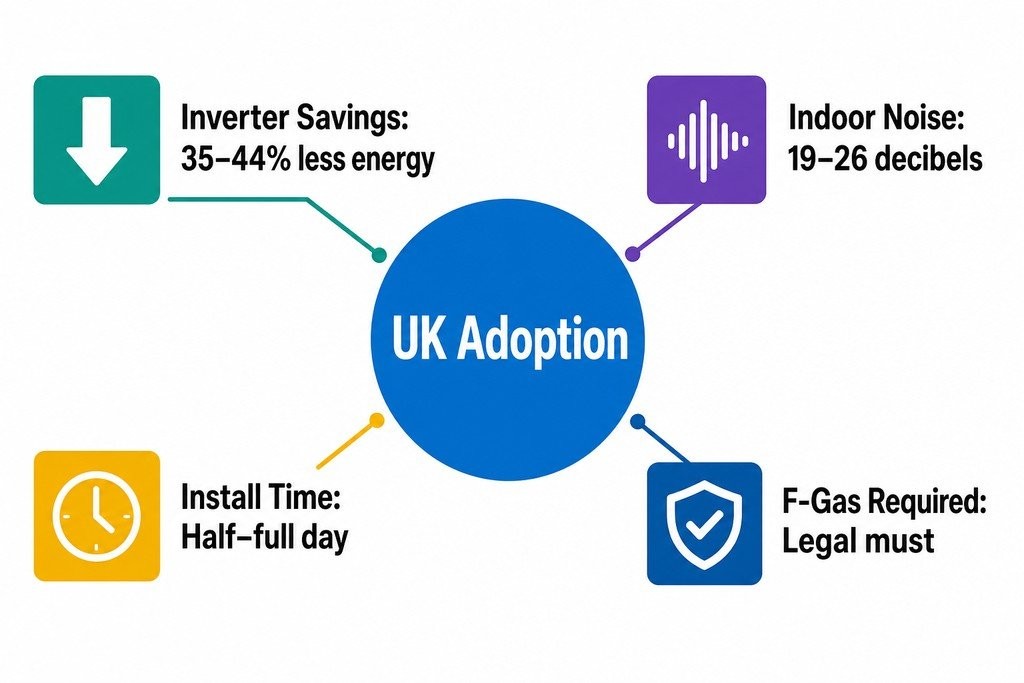
Most modern wall mounted units use inverter technology, meaning the compressor adjusts its speed rather than switching fully on or off. This makes a meaningful difference to running costs. Research cited via Onrec, referencing a ResearchGate study on HVAC energy consumption, found that inverter systems can use around 35% to 44% less electricity compared to non-inverter models.
Many units also work as heat pumps, reversing the cycle to warm your home in cooler months. That makes them a genuinely year-round solution, not just a summer purchase.
Split System vs Through-Wall Unit
These are the two main types of fixed wall-mounted cooling systems available in the UK. A split system uses two separate components: an indoor unit on the interior wall and an outdoor unit fixed externally, connected by refrigerant pipework through a small hole in the wall. A through-wall unit is a single self-contained appliance that fits into a sleeve cut through the wall itself, requiring no separate outdoor unit but involving more invasive installation.
Both achieve cooling, but they differ considerably in installation method, running efficiency, and which properties they suit.
| Feature | Split System | Through-Wall Unit |
|---|---|---|
| Components | Separate indoor and outdoor units | Single self-contained unit |
| Wall opening required | Small hole for pipework | Large sleeve cut through wall |
| Installation invasiveness | Low | High |
| Energy efficiency | High (inverter technology available) | Lower |
| Noise levels indoors | Low | Medium to high |
| Best suited for | UK homes, bedrooms, living rooms | Outbuildings, offices |
| Heat pump function | Commonly available | Less common |

Choosing the Right System for Your Guildford Home
For most Guildford terraced or semi-detached homes, whether in Onslow Village, Burpham, or the town centre, a split system is the more practical choice. The indoor unit mounts neatly on the wall, the outdoor unit sits on a bracket outside, and the pipework runs through a small, discreet hole. Installation is straightforward for a qualified engineer and causes minimal disruption.
Split systems are also quieter and more energy-efficient than through-wall units, qualities that matter especially in living rooms and bedrooms.
Through-wall units require a larger opening to be cut through the external wall, which is more invasive and may not suit all wall constructions. They can work well in outbuildings or offices, but they are less common in UK homes and offer fewer efficiency options than modern inverter split systems.
Guildford has a significant number of period and older properties, particularly in areas such as the Mount, Shalford Road, and parts of the town centre, many of which feature solid brick or stone walls. If your property has cavity walls, solid brick construction, or any form of cladding, speak to a qualified engineer before deciding on either route.
For larger homes, a multi-split system allows one outdoor unit to serve multiple indoor units across different rooms, which can be a cost-effective option if you need cooling in more than one space.
Key Factors to Consider Before Buying
Several practical details will shape which unit is right for your home and how well it performs once installed.
BTU output tells you the unit’s cooling and heating power. Match it to your room size: too small and it will struggle; too large and it will cycle inefficiently. Room dimensions, ceiling height, and the number of windows all influence the right output.
Energy rating is worth scrutinising carefully. Look for a high SEER (Seasonal Energy Efficiency Ratio) and an A or above classification under current UK standards.
Noise levels matter most for bedrooms. Most quality split systems operate at around 19 to 26 decibels indoors, which is quieter than a normal conversation.
Installation position affects performance. Research published in the ScienceDirect Journal of Building Engineering found that mounting a unit at the centre of a wall and setting the air vane to its middle position can meaningfully improve air distribution throughout the room.
Condensate drainage is a practical detail that is easy to overlook. The indoor unit produces water as it cools, which needs a drainage route, either by gravity or a small pump. If your chosen wall does not allow for easy drainage, expect additional installation costs.
Outdoor unit placement requires adequate airflow, should not cause noise issues for neighbours, and may require planning permission in certain cases.
| Factor | What to Look For | Why It Matters |
|---|---|---|
| BTU output | Matched to room size, ceiling height, and glazing | Prevents under- or over-sizing the unit |
| Energy rating | High SEER, A-rated or above | Directly affects running costs |
| Noise levels | 19 to 26 dB indoors for quality split systems | Important for bedrooms and living rooms |
| Installation position | Centre of wall, mid-position air vane | Improves air distribution throughout the room |
| Condensate drainage | Gravity drain or pump available | Avoids additional installation costs and complications |
| Outdoor unit placement | Adequate airflow, minimal noise impact on neighbours | May affect planning permission requirements |
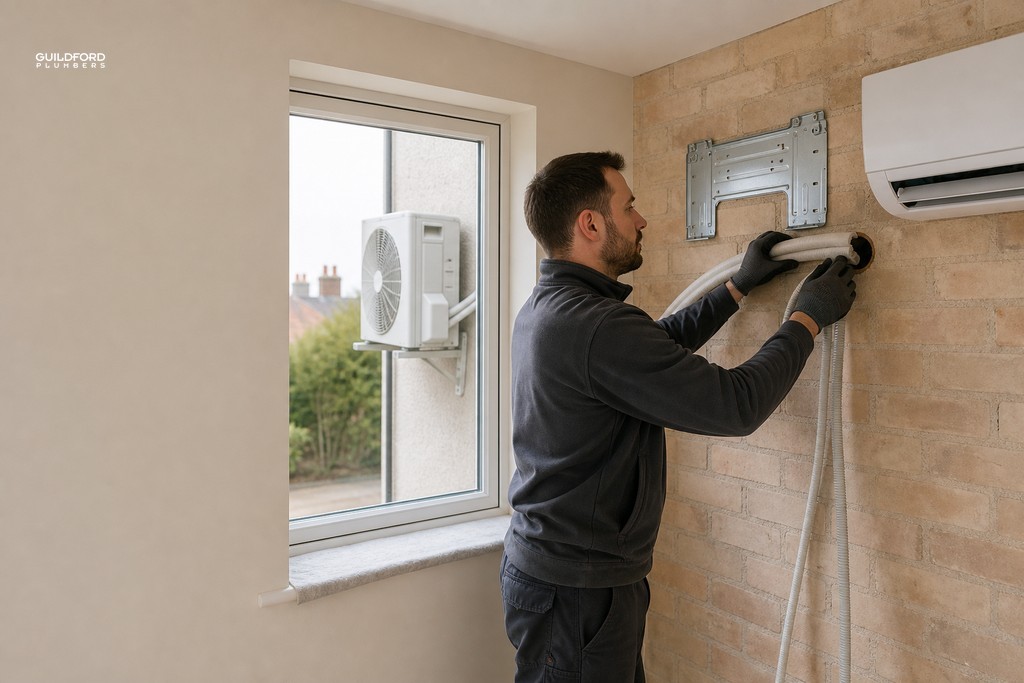
What Wall Mounted Air Conditioner Installation Involves
For a single room, a typical split system installation follows these steps:
- A core hole is drilled through the external wall to route the refrigerant pipework, electrical cabling, and condensate drain.
- The indoor unit is mounted on a bracket at the correct height.
- The outdoor unit is secured externally.
- The two units are connected and pressure-tested.
- The refrigerant is charged and the system is commissioned.
The whole process usually takes half a day to a full day for a single room, depending on wall construction and how far the pipework needs to run.
F-Gas Certification: A Legal Requirement
Refrigerant handling is legally restricted to engineers who hold an F-Gas qualification. This confirms they are trained to handle refrigerants safely and in line with UK regulations. Hiring an uncertified person is illegal, could void your warranty, and may leave you with a system that fails prematurely.
Always ask for proof of F-Gas certification before any work begins, along with relevant electrical qualifications for the wiring involved.
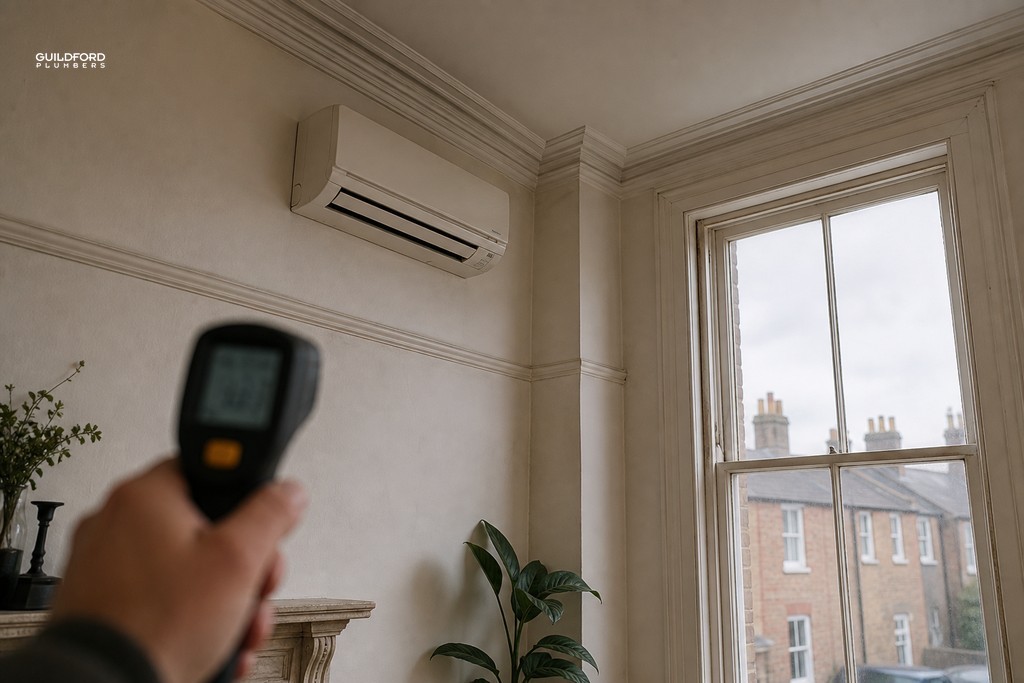
Running Costs and Practical Limitations
Running costs depend on your current electricity tariff, how often you use the system, and the energy efficiency rating of the unit. A well-sized inverter unit used during warmer months should be relatively economical to run. In older Guildford properties with poor insulation, the unit will need to work harder to maintain temperature, which increases costs. It is worth calculating your expected usage against your current tariff before purchasing.
Several practical limitations are also worth understanding before you commit.
Thermal stratification in heating mode: Research published in ScienceDirect’s Building and Environment journal found that warm air from wall-mounted units in heating mode tends to rise and concentrate near the ceiling due to thermal buoyancy, creating a noticeable temperature difference between head height and floor level.
Rental properties: You will almost certainly need your landlord’s written consent before installation.
Listed buildings and conservation areas: Guildford has several conservation areas where planning permission may be required even for the outdoor unit alone. It is worth checking with Guildford Borough Council if you are unsure whether your property is affected.
Solid stone walls: Core drilling is more complex and may add time and cost to the installation, a factor particularly relevant to older properties in and around the town centre.
None of these are reasons to rule out a wall mounted system, but they deserve honest consideration before you commit.
When to Call a Local Guildford Professional
Because air conditioning is still relatively uncommon in UK homes, most homeowners benefit from an on-site assessment before choosing a system. A qualified local engineer can evaluate your wall construction, identify the best position for both units, check condensate drainage options, confirm whether your electrical supply needs upgrading, and give you a reliable quote based on your actual property.
When choosing an installer, verify their F-Gas certification as a minimum. If the job involves work near a gas supply, also confirm Gas Safe registration. Genuine customer reviews from local homeowners add another useful layer of reassurance. A trustworthy installer will give you a written quote, answer your questions clearly, and flag any limitations specific to your property without pushing you towards upgrades you do not need.
At Guildford Plumbers, we have over 12 years of hands-on experience and understand the specific challenges of older and period properties across Guildford and the surrounding areas, including Merrow, Worplesdon, and Godalming. If you are thinking about wall mounted cooling and want straightforward advice from people who know your area, we are happy to help. Get in touch today for a no-pressure consultation and let us assess your home properly before you make any decisions.
Frequently Asked Questions
- Do I need planning permission to install a wall mounted air conditioner in Guildford?
- In most cases, permitted development rights cover the installation of an outdoor unit without formal planning permission. However, if your property is listed or sits within one of Guildford’s conservation areas, different rules apply. Check with Guildford Borough Council before proceeding.
- How long does a wall mounted air conditioner installation take?
- A single-room split system typically takes half a day to a full day to install. The timeframe depends on wall construction, how far the pipework needs to run, and whether any drainage complications arise. Solid stone or thick brick walls may add time.
- Can a wall mounted air conditioner heat my home in winter?
- Yes. Most modern split systems include a heat pump function that reverses the cooling cycle to deliver warmth, making them usable year-round. In heating mode, warm air can rise and concentrate near the ceiling, so positioning and airflow direction matter for overall comfort.
- What BTU output do I need for my room?
- BTU requirements vary by room size, ceiling height, glazing, and insulation. As a rough guide, a living room of around 20 square metres may need approximately 9,000 BTU, though a proper assessment by a qualified engineer will give you a more accurate figure for your specific space.
- Is a wall mounted air conditioner expensive to run?
- Running costs depend on your electricity tariff, usage frequency, and the unit’s energy rating. A high-efficiency inverter model costs considerably less to run than a non-inverter equivalent. Properties with poor insulation will see higher costs, as the system works harder to hold the set temperature.
- Can I install a wall mounted air conditioner myself?
- No. Refrigerant handling is legally restricted to F-Gas certified engineers in the UK. Attempting installation without the correct qualifications is illegal, will likely void your warranty, and risks the system failing. Always use a qualified, certified installer.