

Key Takeaways
Split air conditioners offer Guildford homeowners superior cooling performance, energy savings, year round heating, and cleaner air compared to portable or passive alternatives.
- Split air conditioners outperform portable units by cooling more effectively, using less electricity, and maintaining a steadier room temperature without the noise or floor space requirements.
- Inverter technology in modern split systems adjusts compressor speed to match real demand, reducing energy consumption compared to fixed speed or portable alternatives.
- Most split systems include a heat pump mode, meaning the same unit that cools your home in summer can provide efficient supplementary heating in winter, adding year round value.
- Built in air filtration in split units captures dust and allergens as air circulates, offering a practical comfort benefit for households with allergy sufferers or young children.
- Installation quality matters; refrigerant work must be handled by F Gas certified engineers and the electrical connection must meet UK wiring regulations to protect performance and warranty.
Summers in the UK are changing. After the record-breaking 40.3°C temperatures recorded in 2022, many homeowners across Guildford and the wider Surrey area no longer treat home cooling as an optional extra. If you have been researching your options, you have likely come across split air conditioners and wondered whether all the enthusiasm is justified or just marketing noise.
For most UK homes, a split system genuinely stands apart from the alternatives. This guide explains why in plain, practical terms, without technical jargon or spec-sheet comparisons. It is a straightforward decision-making guide to help you understand whether a split system makes sense for your home, budget, and property type.
What Makes Split Air Conditioners Well Suited to UK Homes
Split air conditioners combine energy efficiency, year-round versatility, and low installation disruption in a way that most alternatives cannot match. According to SAGE Journals / Building Services Engineering Research and Technology, ductless split air conditioners account for 70% of all air conditioning systems sold worldwide. That figure reflects genuine suitability across a wide range of building types and climates, including older UK housing stock.
The core advantages for British homeowners are:
- Energy efficiency — inverter technology adjusts power use to match actual demand, reducing running costs compared to portable units.
- Year-round use — most models include a heat pump mode for winter heating as well as summer cooling.
- Quiet operation — the compressor sits outside, so indoor noise levels are far lower than portable alternatives.
- No ductwork needed — ideal for older properties where installing ducted systems would be impractical or costly.

How Split Systems Compare to Other Cooling Options
When homeowners start comparing cooling options, the three most common alternatives are portable air conditioners, window units, and traditional fans. Each has trade-offs worth understanding before you spend any money.
Portable Units vs Split Systems
Portable air conditioners typically draw more power while delivering less effective cooling than a split unit of comparable capacity. Their limitations are structural, not incidental:
- They require a hot air exhaust hose vented through a window, which lets warm air back in and undermines their own performance.
- They tend to be noisier and take up floor space.
- They often struggle to maintain a consistent room temperature.
A split system is fixed, discreet, and designed to cool a defined space efficiently. Inverter-driven models vary compressor speed to match demand, avoiding the energy spikes of fixed-speed alternatives. As cited by Atlantis Press, air conditioners in homes and offices consume between 50% and 65% of total electrical energy, which makes choosing the right technology a significant financial decision. For a fuller breakdown, see our guide on the portable vs split air conditioner debate.
Why Fans and Open Windows Fall Short in Summer
Passive cooling works adequately in mild conditions but has clear limits when temperatures rise sharply or humidity climbs. In Surrey, late July and August can bring sustained warm spells, particularly in built-up parts of Guildford town centre and low-lying neighbourhoods such as Slyfield and Bellfields, that passive airflow simply cannot handle.
A fan moves warm air around; it does not lower the actual room temperature. Open windows at night can help, but they introduce noise, pollen, and security concerns. A properly sized split system removes heat from the room rather than redistributing it, which is a fundamentally more effective approach. The limitations of portable air conditioners are well documented, and passive cooling has its own ceiling too, one that many Guildford homeowners reach several times each summer.
| Cooling Option | Cools Actual Room Temperature | Energy Efficiency | Noise Level (Indoors) | Year-Round Use | Ductwork Required |
|---|---|---|---|---|---|
| Split Air Conditioner | Yes | High | Low | Yes (heating and cooling) | No |
| Portable Air Conditioner | Yes, but limited | Low to medium | High | Cooling only | No |
| Electric Fan | No | High | Medium | Limited | No |
| Open Windows | No | N/A | Varies | Limited | No |
How Split Systems Perform in Older Guildford Properties
British homes present specific installation challenges, and split systems handle them better than most people expect. Older properties, which make up a large share of the housing stock in areas such as Merrow, Burpham, and Worplesdon, often have thick walls, unusual room layouts, and limited options for routing ductwork. Victorian and Edwardian terraces and semi-detached houses are common throughout these neighbourhoods.
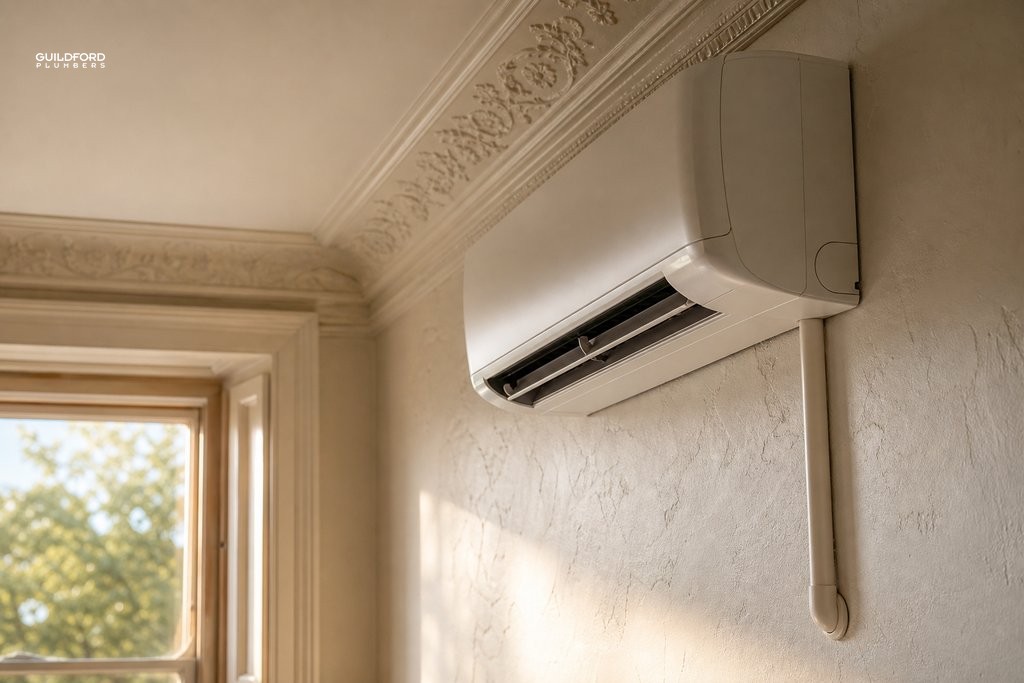
Because split systems require no ductwork, they can be retrofitted into almost any room with access to an external wall. The indoor unit mounts high on the wall, the refrigerant pipe runs through a small hole to the outdoor compressor, and the installation footprint is minimal. Research published by ScienceDirect / Energy and Buildings confirms that ductless split units are the primary residential air conditioning system across Europe and Asia, with installation positioning and heat exchanger maintenance identified as key factors in consistent long-term performance.
Energy Savings and Running Costs
The energy efficiency case for split systems is one of the strongest reasons homeowners choose them over simpler alternatives. The savings are largely driven by inverter technology:
- The compressor ramps up and down in response to actual cooling demand, rather than switching on and off at full power.
- This avoids the energy spikes of fixed-speed units and keeps consumption lower across a typical operating session.
- A split unit can cool effectively while using noticeably less electricity than a portable unit running at full capacity for the same period.
The global split systems market is projected to grow at a compound annual growth rate of 4.88% between 2025 and 2030, according to Mordor Intelligence, reflecting sustained homeowner confidence in the technology as a practical long-term investment.
Year-Round Value: Cooling and Heating in One Unit
Most modern split systems include a heat pump mode, meaning the same unit that cools your living room in August can provide efficient supplementary heating through the colder months. Heat pump heating is generally more energy-efficient than electric resistance heating because it moves heat rather than generating it directly.
For a Guildford homeowner looking to get maximum value from a single installation, this year-round versatility changes the cost calculation considerably. You are not buying equipment that sits unused for eight months. You are investing in a climate control system that earns its keep across all four seasons.
Air Quality and Indoor Comfort Beyond Temperature
Temperature is not the only comfort factor a split system improves. Most modern indoor units also provide:
- Multi-stage air filtration — captures dust, allergens, and airborne particles, which is a meaningful benefit for households with allergy sufferers or young children.
- Humidity management — reduces the muggy, uncomfortable feeling common on warm summer evenings.
- Low-noise operation — the indoor unit produces only a low, steady airflow sound, far less disruptive than a portable unit running nearby.
Research from PubMed Central / MDPI highlights that correct installation positioning directly affects both thermal comfort and energy consumption, reinforcing that where and how the indoor unit is placed matters as much as the unit itself.

What to Check Before Installing a Split Air Conditioner
Before committing to an installation, work through these practical checks. Skipping any of them can cause delays or complications once the work begins.
- External wall access — the indoor unit needs a clear route through an external wall for the refrigerant pipe and drainage.
- Electrical supply — split systems typically require a dedicated circuit, and your existing consumer unit may need assessment beforehand.
- Permitted development rules — fitting an outdoor compressor falls within permitted development in most cases in England, but listed buildings and conservation area properties may require planning permission. Parts of central Guildford and some village settings within the borough are designated conservation areas, so confirm your property’s status before proceeding.
- Landlord permission — if you rent, written permission from your landlord is required before any fixed installation takes place.
A qualified installer will assess all of these during a pre-installation survey. If you are unsure about any of them, that conversation is the right place to ask, not after the work has started.
| Pre-Installation Check | What to Consider | Who to Consult |
|---|---|---|
| External wall access | Clear route needed for refrigerant pipe and drainage | Your installer |
| Electrical supply | Dedicated circuit may be required; consumer unit may need assessment | Qualified electrician or installer |
| Permitted development rules | Conservation areas or listed buildings may require planning permission | Guildford Borough Council / installer |
| Landlord permission | Written consent required before any fixed installation | Your landlord |
Choosing the Right Installer in Guildford
Installation quality directly affects how well your system performs and how long it lasts. Two non-negotiables apply:
- Refrigerant handling must be carried out by an F-Gas certified engineer. This is a legal requirement in the UK.
- The electrical connection must meet current UK wiring regulations.
An improperly installed unit can lose a significant portion of its efficiency from day one and may also void the manufacturer warranty. Choosing a qualified, experienced local installer is not just about compliance; it protects the investment you have made.
At Guildford Plumbers, we have been helping homeowners across Guildford and the surrounding Surrey area, including Godalming, Woking, and Cranleigh, keep their homes comfortable and efficient for over 12 years. If you are ready to explore split air conditioning for your home, get in touch with our team today and we will help you find the right solution, installed properly, at a fair price.

Frequently Asked Questions About Split Air Conditioner Benefits
Are split air conditioners suitable for older UK homes?
Yes. Split systems require only a small hole through an external wall for the refrigerant pipe, so no ductwork is needed. This makes them straightforward to retrofit into Victorian terraces, Edwardian semis, and other older property types common across Guildford and Surrey. Most older homes can accommodate a split system without structural changes.
Can a split air conditioner be used for heating as well as cooling?
Most modern split systems include a heat pump mode that provides efficient supplementary heating in winter, making them a year-round climate control solution. Heat pump heating is generally more energy-efficient than direct electric heating because it transfers heat rather than generating it. This makes a split system a practical purchase across all four seasons.
Do I need planning permission to install a split air conditioner in Guildford?
In most cases, fitting an outdoor compressor unit falls within permitted development in England and does not require planning permission. Properties in conservation areas or with listed building status may need approval. Parts of central Guildford fall within designated conservation areas, so check your property’s status before proceeding.
How noisy is a split air conditioner indoors?
Split systems are significantly quieter than portable air conditioners. Because the compressor is located outside, the indoor unit produces only a low, steady airflow sound that most people find unobtrusive, even in bedrooms or home offices. Noise levels vary by model, so your installer can advise on quieter options if this is a priority.
Is F-Gas certification required for split air conditioner installation in the UK?
Yes. Any engineer handling refrigerant as part of a split system installation must hold a valid F-Gas certification. This is a legal requirement under UK regulations. Installing a split system without a certified engineer is not compliant and may also affect your warranty and home insurance.
How does a split air conditioner improve air quality?
Most split system indoor units include built-in filtration that captures dust, pollen, and airborne particles as air circulates through the unit. This can benefit households with allergy sufferers or young children. The units also help manage indoor humidity, reducing the sticky discomfort common during warm UK summer evenings.