Key Takeaways
Portable air conditioners often underdeliver due to reduced cooling output, high noise levels, venting difficulties, and poor energy efficiency in real UK homes.
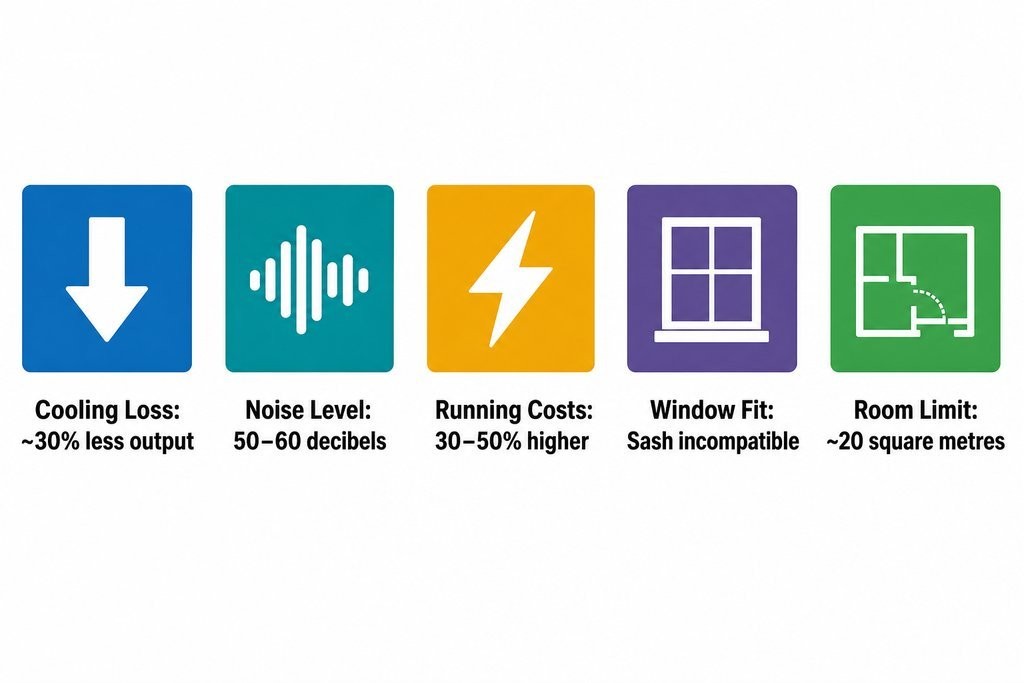
- Portable air conditioners typically deliver around 30% less cooling than their stated BTU rating, meaning a unit sold for a medium room may only cool a small one effectively.
- Portable AC noise levels sit between 50 and 60 decibels during normal use, comparable to a washing machine running in the same room, making overnight or office use genuinely disruptive.
- Single hose portable units create negative pressure that draws warm outside air back in, making portable air conditioner efficiency 30 to 50% worse than equivalent window units in running costs.
- Portable AC venting problems are common in homes with sash or double glazed windows, limiting where a unit can be used and reducing the flexibility that made it appealing.
- If you are cooling a space larger than 15 to 20 square metres or running a unit all day without comfort, a properly installed split system is worth considering for better results.
Every summer, the same scene plays out in homes across Guildford and the wider Surrey area. Temperatures climb, sleep becomes difficult, and homeowners start searching for a fast and affordable cooling fix. Portable air conditioners seem like the obvious answer. You can order one online, plug it in, and have cool air within the hour. No engineer, no installation, no fuss. The reality, unfortunately, tends to be more complicated. Understanding the limitations of portable air conditioners before you buy can save you real money, frustration, and noise.
This article takes an honest look at why portable units so often fall short in real homes, and when it might be worth thinking differently about your cooling setup.
Why Homeowners Choose Portable Air Conditioners
The appeal is straightforward. There is no need to drill holes in walls, negotiate with landlords, or arrange professional installation. You wheel the unit into a room, feed the exhaust hose through a window, and switch it on. For renters especially, that flexibility is often the deciding factor. The upfront cost also looks reasonable compared to installed alternatives. It is usually only after a few days of real use that homeowners notice the gap between what was promised and what the unit actually delivers.

The Gap Between Advertised and Real-World Cooling Output
Portable units often do not cool as effectively as advertised. Manufacturer BTU ratings are measured under ideal laboratory conditions that bear little resemblance to a typical home in Guildford or the surrounding Surrey commuter belt. Rooms with south-facing windows, older insulation, high ceilings, or multiple heat sources such as computers and kitchen appliances can all reduce a unit’s effective output considerably.
According to Energy-One, portable air conditioners typically deliver around 30% less actual cooling than their stated BTU rating suggests. A unit marketed for a medium-sized room may only manage to cool a small one in practice. Add in a Surrey summer afternoon flooding through glazed windows, and many homeowners find the unit running flat out while the room stays stubbornly warm. This gap between advertised and real-world output is something most buyers only discover after the return window has closed.
Noise Levels Inside the Room
Portable units are considerably noisier than most buyers expect. Because the compressor, fan, and all mechanical components sit inside the room with you, noise levels are much higher than those of split or wall-mounted systems. Most portable units operate between 50 and 60 decibels during normal use, which is roughly equivalent to a running washing machine in the same room.
For daytime cooling that may be manageable, but in a bedroom overnight or during a video call, that constant compressor hum becomes genuinely intrusive. Unlike split systems, where the noisy components sit outside the building, there is no way to fully escape the sound of a portable unit while it is running. For many families in Guildford, especially those in smaller terraced or semi-detached homes across areas such as Onslow Village, Burpham, or Merrow, noise is often the primary reason the unit ends up stored in a cupboard by early August.
Why Portable Air Conditioners Cost More to Run
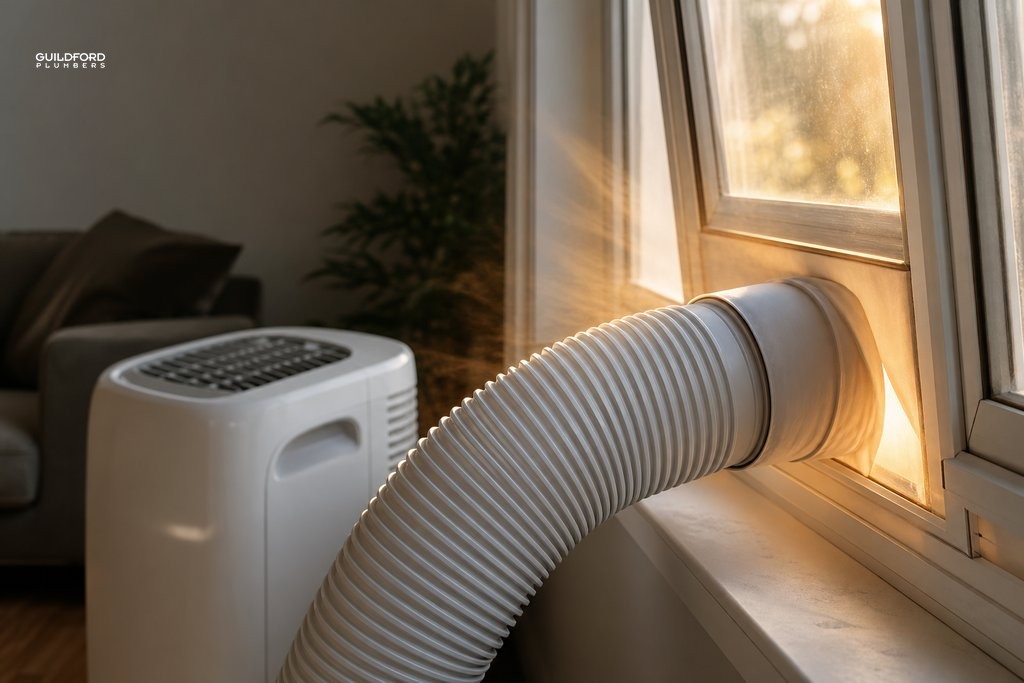
The efficiency problem is built into the design. Single-hose models, which make up the majority of units sold, pull air from inside the room, cool it, and then expel hot air out through the window hose. Expelling indoor air creates a slight negative pressure in the room, which draws warm outside air back in through every gap, crack, and door seal in the building. The unit then has to work harder to cool air it has essentially just let back in.
Running costs reflect this directly. Energy-One estimates that portable air conditioners cost 30 to 50% more to run in electricity compared to window units delivering the same cooling output. Research published on ScienceDirect found that even with optimised condenser paths and condensate management, efficiency improvements in portable units appear to be capped at around 8.1%, which illustrates how deep-rooted the design constraints are.
| Factor | Portable Air Conditioner | Split Air Conditioner |
|---|---|---|
| Real-world cooling output vs. rated BTU | ~30% less than stated | Closer to rated output |
| Noise level indoors | 50 to 60 dB (compressor inside room) | Low (compressor outside) |
| Running cost vs. equivalent window unit | 30 to 50% higher | More efficient |
| Venting requirement | Exhaust hose through window required | No hose; external unit handles heat |
| Suitability for larger or open-plan spaces | Limited; typically up to ~20 m² | Suitable for larger areas |
| Installation needed | None (plug and use) | Yes (professional installation) |
Venting and Window Hose Problems in Guildford Homes
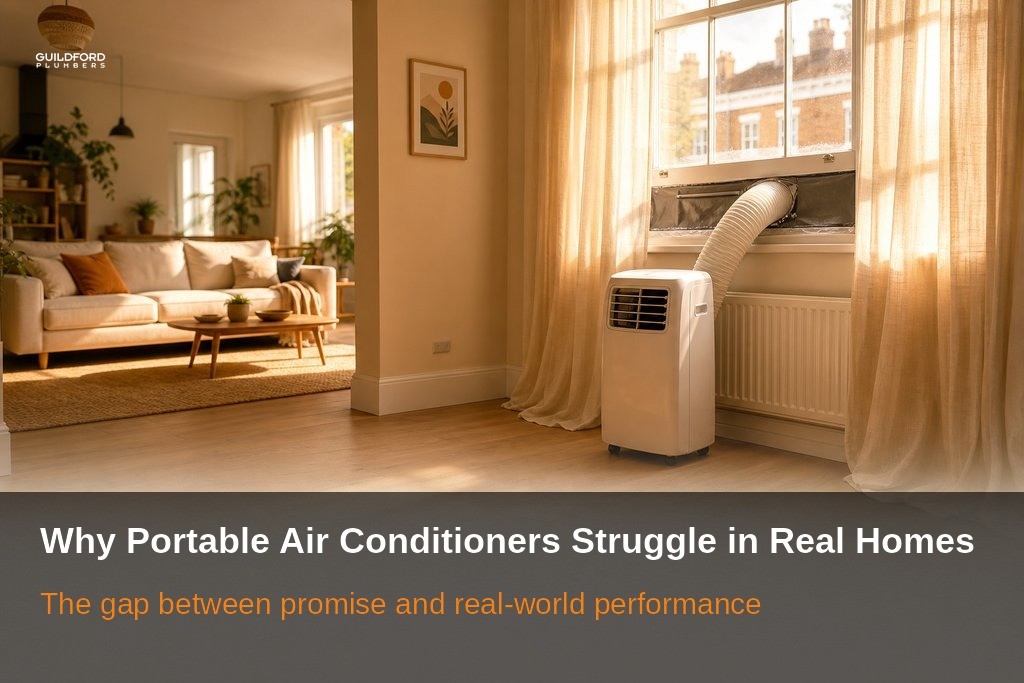
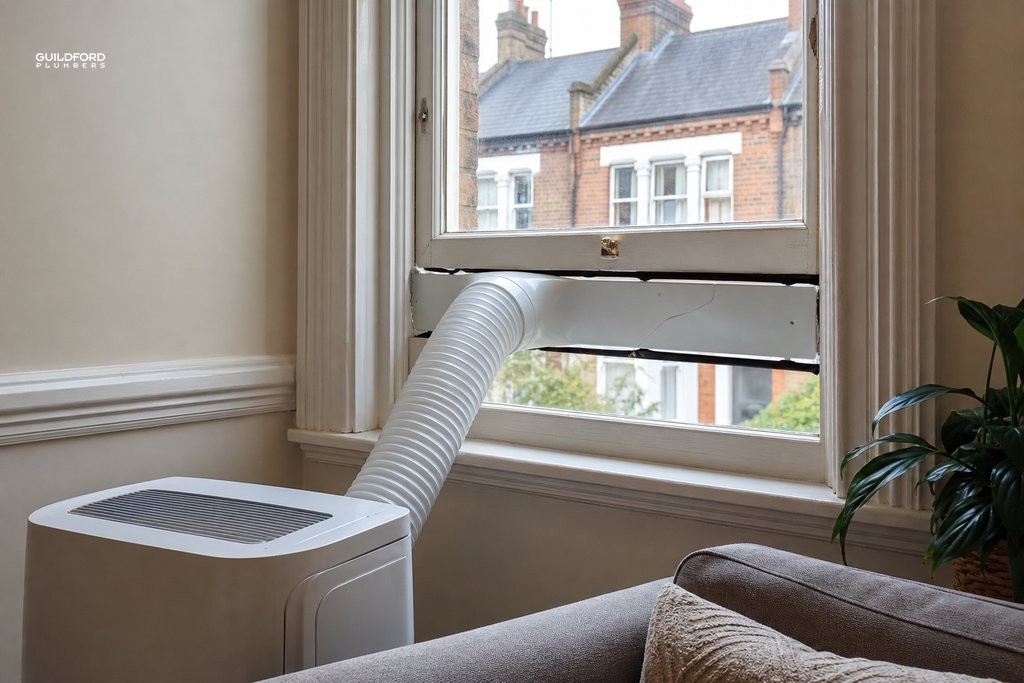
Every portable air conditioner must vent hot air outside, and that creates practical problems the product photos rarely show. The exhaust hose is typically short, which restricts where the unit can actually sit in a room. The hose also radiates heat back into the space as hot air travels through it, partially undoing the cooling just produced. Sealing the window gap around the hose is a further issue. The foam or plastic kits supplied rarely create a truly airtight seal, so warm outside air seeps back in around the edges.
These venting challenges become especially awkward in homes with sash windows or modern double-glazed units, both of which are common across Guildford’s mix of Victorian terraces, particularly in areas like Park Barn, Stoughton, and the town centre, and the newer builds found further out towards Ash and Worplesdon. Sash windows do not open in a way that accommodates a standard hose kit cleanly, and double-glazed frames can make it difficult to create even a temporary seal without risking damage. As a result, the unit can often only be used effectively in one or two rooms, which undermines the flexibility that made it appealing in the first place.
| Window Type | Compatibility with Standard Hose Kit | Common Issue |
|---|---|---|
| Casement windows | Best fit | Minor gap sealing required |
| Sash windows | Poor fit | Hose kit does not sit cleanly; warm air re-enters |
| Modern double-glazed frames | Difficult | Risk of frame damage when creating a temporary seal |
Cooling Capacity Limits for Larger and Open-Plan Spaces
In most cases, a single portable unit cannot cool a whole home. Portable unit cooling capacity typically ranges between 5,000 and 20,000 BTUs, according to Persistence Market Research. That places a firm ceiling on the ability to manage larger rooms, open-plan layouts, or connected living spaces. A modest open-plan kitchen and living area in a Guildford family home can easily exceed what a single portable unit can handle at maximum output.
The practical result is that many homeowners end up buying a second unit for another room, doubling the noise, doubling the running costs, and still not solving the problem of uneven cooling throughout the house. When you weigh this up against the portable vs split air conditioner question, the case for a properly installed system becomes considerably clearer for anyone cooling more than one small room.
When a Properly Installed Alternative Makes More Sense
There is a point at which a portable unit simply cannot do the job. Recognising that point before spending more money on a temporary fix is genuinely useful. Consider an installed alternative if:
- The room is larger than roughly 15 to 20 square metres.
- The unit runs all day just to maintain a comfortable temperature.
- Noise is affecting your sleep or your ability to work from home.
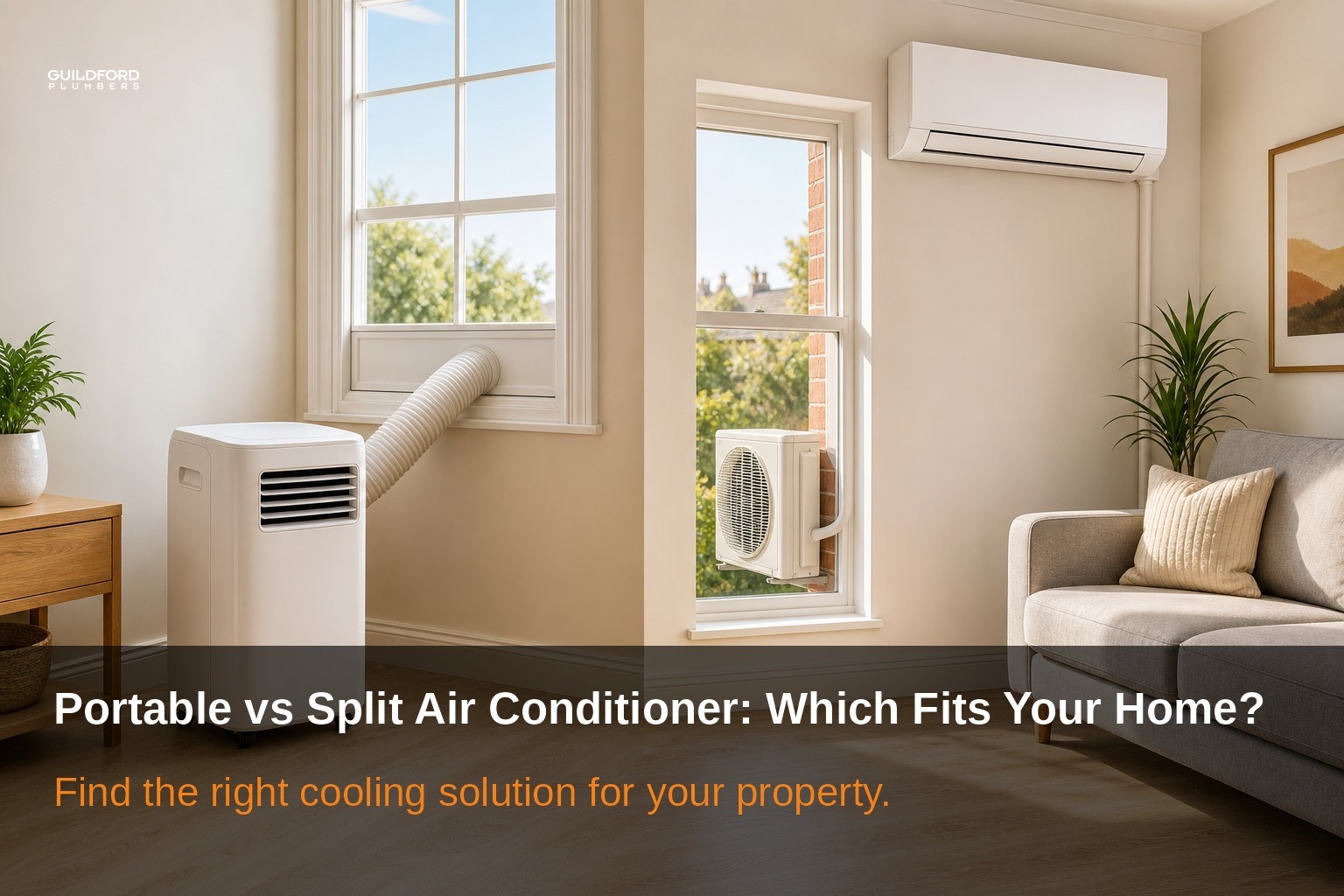
If any of these applies, a portable unit is unlikely to improve with time. The benefits of a split air conditioner, including quieter operation, better energy efficiency, and consistent coverage across a larger space, become increasingly relevant as your cooling needs grow.
While air conditioning installation falls outside the scope of plumbing and heating work, home comfort is something we understand well at Guildford Plumbers. If your home is struggling with warmth and you suspect a poorly performing boiler, faulty radiators, or an unresolved heating issue is also playing a role, that is something we can help with. Getting your heating and hot water systems working properly is often a sensible first step before adding more electrical appliances to a home that needs a proper assessment. Our team has been handling exactly this kind of work across Guildford and the surrounding Surrey area for over 12 years.
If your home comfort is suffering this summer, whether from heat, heating faults, or anything in between, reach out to Guildford Plumbers. We are local, we are straightforward, and we are always happy to help you work out the best next step for your home.
Frequently Asked Questions About Portable Air Conditioner Limitations
Why does my portable air conditioner struggle to cool the room even on its highest setting?
Portable units typically deliver around 30% less cooling than their stated BTU rating in real-world conditions. Factors such as south-facing windows, poor insulation, high ceilings, and heat-generating appliances all reduce effective output. If the room exceeds roughly 15 to 20 square metres or receives strong direct sunlight, even a high-BTU portable unit may be insufficient for the space.
Are portable air conditioners significantly noisier than split systems?
Yes. Portable units house the compressor and fan inside the room, producing 50 to 60 decibels during normal operation, comparable to a washing machine running nearby. Split systems place the noisy components outside the building, making them far quieter indoors. This difference is particularly noticeable in bedrooms and home offices where background noise is disruptive.
How much more does it cost to run a portable air conditioner compared to other types?
Portable air conditioners can cost 30 to 50% more in electricity than window units producing equivalent cooling. The main reason is the negative pressure created by single-hose designs, which draws warm air back into the room and forces the unit to work harder. This inefficiency is structural and cannot be resolved by changing settings or filters.
Can I use a portable air conditioner with sash windows in a Guildford home?
It is possible but awkward. Standard hose kits are designed for casement windows and do not fit cleanly into sash window openings. This leaves gaps that allow warm outside air to re-enter, reducing efficiency. Homeowners in Guildford’s older Victorian terraces often find the venting arrangement too disruptive to use consistently.
At what point should I consider a split air conditioner instead of a portable unit?
If the room is larger than 15 to 20 square metres, the unit runs continuously without achieving a comfortable temperature, or noise is disrupting sleep or work, a split system is likely a better fit. Split systems offer quieter operation, greater energy efficiency, and more reliable cooling capacity for larger or open-plan spaces.
Do portable air conditioners work in open-plan living spaces?
Generally not well. A typical open-plan kitchen and living area in a Guildford family home can easily exceed the effective range of a single portable unit. Multiple heat sources, a higher volume of air, and natural airflow between connected spaces mean portable units often run at full capacity while delivering only partial cooling across the area.