Key Takeaways
Matching your air conditioner to your room size and heat load prevents wasted energy, hidden damp risks, and costly oversizing or undersizing mistakes.
- Oversized units cool air quickly but fail to reduce humidity, which can lead to mould growth and structural damage in your home.
- Room floor area is only the starting point. Ceiling height, window orientation, insulation, occupancy, and appliances all affect how much cooling capacity you actually need.
- A practical starting range for UK homes is 100 to 140 BTUs per square metre, which translates to roughly 0.03 to 0.04 kW per square metre before any room specific adjustments.
- Improving roof insulation before buying a unit can let you choose a smaller, more affordable model and lower your ongoing running costs.
- For older properties, multi room setups, or installations involving electrical work, a professional survey gives far more reliable guidance than any online calculator.
Choosing the right air conditioner for your home feels straightforward until you realise how many factors actually influence whether a unit will keep you comfortable or leave you frustrated. A proper air conditioner size guide does more than hand you a chart to squint at. It helps you understand why certain rooms need more cooling power, why a unit that seems generously sized can actually cause problems, and how to approach the decision with confidence rather than guesswork. Whether you are cooling a compact bedroom in a Victorian terrace or a large open-plan kitchen in a modern new-build, getting the capacity right from the start saves money, reduces energy waste, and protects your home from hidden damp and mould risks.
This guide focuses specifically on the relationship between your room and the unit’s output. It sits within the broader air conditioner buying guide topic. Related questions, including how to use an air conditioner BTU calculator and how to answer what size air conditioner do I need for your exact dimensions, are covered in separate dedicated articles. The goal here is to build your reasoning so that any output figure you encounter on a product listing actually means something to you.
Why Getting AC Unit Size Right Matters
Many homeowners assume that a larger air conditioner is simply a safer bet. In practice, oversizing creates a specific set of problems that a correctly matched unit would avoid entirely.
An oversized unit cools air temperature quickly but shuts off before running long enough to reduce humidity, actively promoting mould growth. An undersized unit runs continuously, struggles to reach the target temperature, and burns through electricity without delivering real comfort. Both scenarios inflate running costs and shorten the lifespan of the unit.
According to the EcoFlow UK Blog, a 14,000 BTU unit in a 10m² bedroom may cool the space quickly but leave humidity levels unchecked, which poses a structural and health risk that many people do not associate with buying too powerful a unit. Research from ClimateWorks suggests that correctly sized air conditioning can meaningfully reduce energy waste compared to poorly matched systems, though the actual saving depends on your specific setup and usage patterns. As Chris Barnes, air conditioning expert at CHOICE, puts it: “Bigger isn’t always better, and smaller isn’t always more economical. Aim for the sweet spot.”

What Is Cooling Load and Why Does It Matter?
Cooling load is the total amount of heat energy an air conditioner must remove from a room to reach and maintain a comfortable temperature. It is not simply a function of floor area, though that is the starting point.
Heat enters a room through walls, ceilings, windows, and floors, as well as from people, appliances, and direct sunlight. The unit must counteract all of those heat sources simultaneously, which is why two rooms with identical square footage can need meaningfully different cooling capacities.
Key factors that influence cooling load include:
- Ceiling height: Standard UK ceilings sit between 2.4 and 3 metres, but older properties, including the many Victorian and Edwardian homes found throughout Guildford, often have higher ceilings that hold considerably more air volume.
- Insulation quality: Poor loft or wall insulation allows heat to pour in, raising the burden on any cooling system.
- Window orientation: South-facing windows receive far more direct sunlight than north-facing ones.
- Occupancy: Each person in the room adds warmth that the unit must manage.
- Appliances: Devices such as ovens, televisions, and gaming PCs can each add a notable amount to the cooling load, with estimates often cited in the range of 400 to 600 BTUs per device, though this varies considerably by model and usage.
The Australian Institute of Refrigeration, Air Conditioning and Heating confirms that accurate AC sizing requires factoring in all of these variables, not room area alone, to avoid significantly over- or under-sized systems.
| Cooling Load Factor | Effect on Capacity Needed | Typical Impact |
|---|---|---|
| Ceiling height above 2.7m | Increases air volume to cool | Moderate to high increase |
| Poor loft or wall insulation | Allows external heat to enter | High increase |
| South-facing windows | Higher solar heat gain | Moderate to high increase |
| Multiple regular occupants | Each person adds body heat | Low to moderate increase |
| High-output appliances (oven, gaming PC) | Raises ambient heat load | Moderate increase |
| North-facing room, well insulated | Lower heat gain overall | May allow smaller unit |
How to Match kW Output to Your Room Size
When you look at an air conditioner’s product listing, the output is typically expressed in kilowatts (kW) or British Thermal Units (BTUs). These measure the same thing: cooling power. One kilowatt equals approximately 3,412 BTUs, so a 3.5 kW unit delivers roughly 12,000 BTUs per hour. For UK buyers, kW tends to be the more common figure on domestic listings, though BTU values still appear frequently on portable and window units.
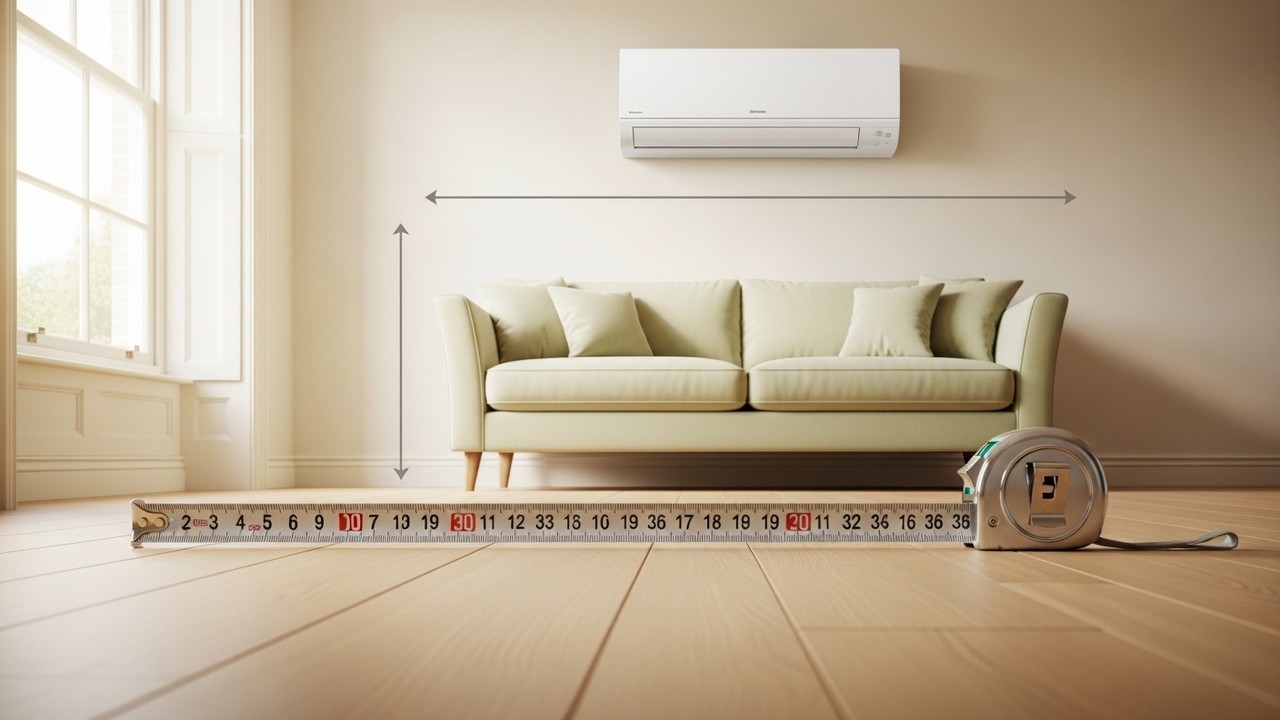
The baseline calculation starts with floor area in square metres. A widely used UK rule of thumb is between 100 and 140 BTUs per square metre, roughly 0.03 to 0.04 kW per square metre, before any adjustments for the factors above. This is a starting figure only, not a final answer.
Typical kW Ranges by Room Type
The ranges below give indicative capacity starting points for common UK room types. Each should be adjusted based on your specific conditions.
- Small bedroom (up to 12m²): approximately 2.0 to 2.5 kW. These rooms cool relatively quickly and typically have lower occupancy, so moderate capacity is usually sufficient.
- Medium bedroom or home office (12 to 20m²): approximately 2.5 to 3.5 kW. Home offices with multiple screens or high-end computers may sit toward the upper end.
- Large bedroom or dining room (20 to 30m²): approximately 3.5 to 5.0 kW. South-facing rooms or those with large windows often need the higher end.
- Open-plan living or kitchen-diner (30m² and above): 5.0 kW and upward, sometimes requiring a multi-unit setup rather than a single installation.
| Room Type | Typical Floor Area | Indicative kW Range | Notes |
|---|---|---|---|
| Small bedroom | Up to 12m² | 2.0 to 2.5 kW | Low occupancy; moderate capacity usually sufficient |
| Medium bedroom or home office | 12 to 20m² | 2.5 to 3.5 kW | Upper end if multiple screens or high-output computers are present |
| Large bedroom or dining room | 20 to 30m² | 3.5 to 5.0 kW | South-facing rooms or large windows push toward higher end |
| Open-plan living or kitchen-diner | 30m² and above | 5.0 kW and above | May require a multi-unit setup rather than a single installation |
When to Adjust the Baseline Estimate
Several conditions call for increasing the baseline capacity figure:
- A south-facing room with large windows absorbs significantly more solar heat than a north-facing room of the same size.
- Poor loft insulation allows heat to pour in from above. Fitting insulation before purchasing a unit could allow you to choose a smaller, cheaper model.
- Multiple regular occupants add meaningful heat load beyond what floor area alone suggests.
- High-output appliances such as gaming PCs, ovens, or large televisions increase the effective cooling demand.
As Chris Barnes advises: “If you don’t have roof insulation, consider installing it. It’ll save you money on running costs, and you can get away with a smaller air conditioner.”
Practical Factors for Guildford Homes
Room dimensions are the foundation, but how a room is actually used matters just as much. A spare bedroom used only a few days a year has very different requirements from a home office where someone works eight hours daily.
Other practical considerations include:
- Ventilation: Rooms with poor natural ventilation trap heat more stubbornly and may need additional capacity.
- Building age and construction: Solid-wall Victorian and Edwardian properties, common across central Guildford, Merrow, and Shalford, retain and transfer heat differently compared to cavity-wall homes built in the 1980s or well-insulated new-builds in areas such as Ash and Burpham.
- Electrical supply: Most split-system air conditioners require a dedicated circuit. Older consumer units may need upgrading before installation can proceed safely.
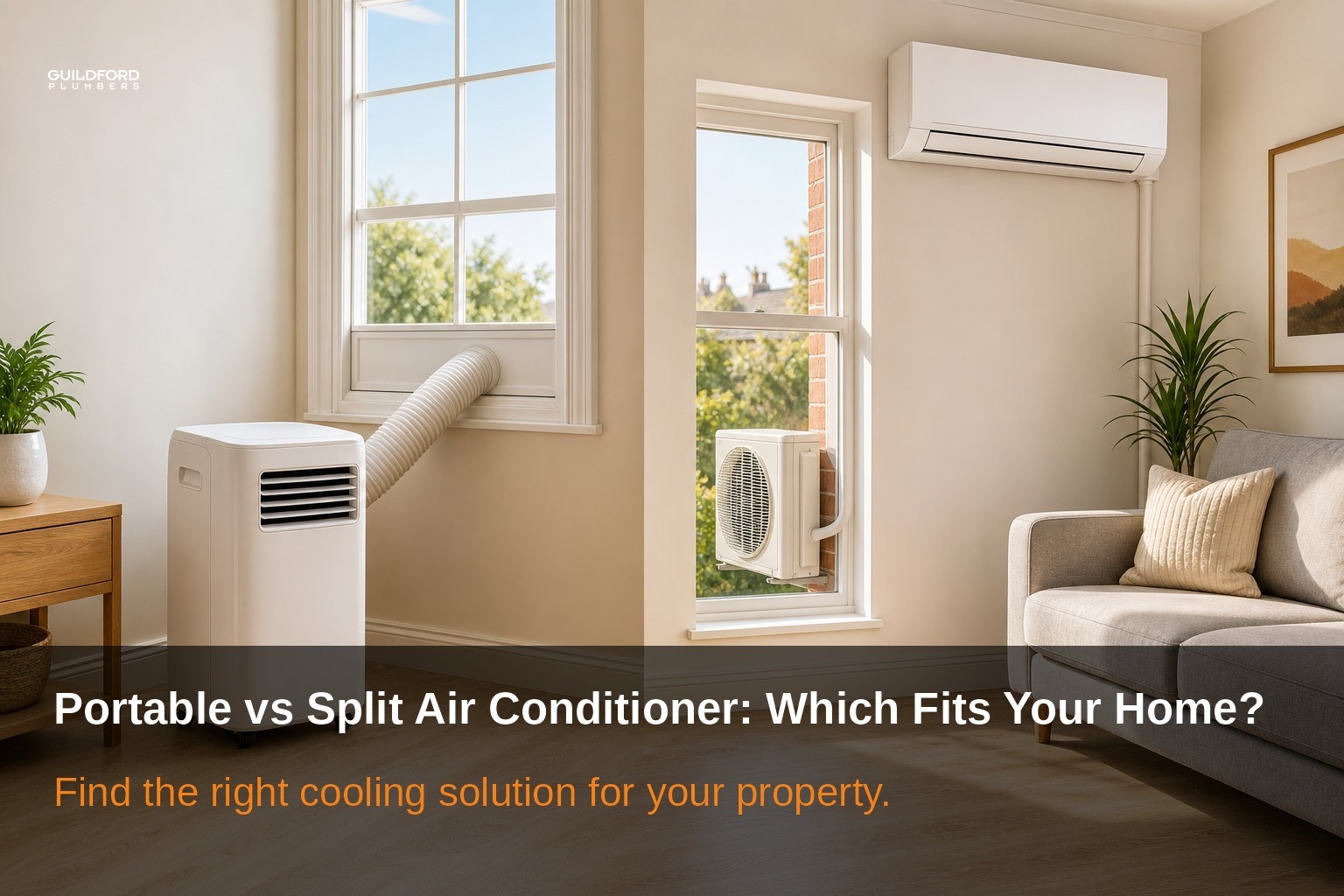
- Installation space: Outdoor units need adequate clearance and airflow. Available wall or floor space, and the practicality of routing pipe and cable, all shape which unit type and capacity is realistically installable.
Residential AC systems in the UK commonly range from around 2.2 kW to 6.5 kW for single-room use. Staying within the range that suits your room avoids expensive over-specification.
What to Check Before Buying or Installing an AC Unit
Before committing to a purchase, a few practical checks protect you from avoidable complications:
- Electrical supply: Confirm your consumer unit can support the model you are considering. Older installations may need upgrading first.
- Planning rules: Local planning rules in Guildford may apply, particularly for listed buildings or properties within conservation areas such as parts of Guildford town centre and villages to the south. Check with Guildford Borough Council’s planning department before installation to avoid delays or enforcement notices.
- Unit positioning: Consider where both the indoor and outdoor components will be located before finalising your choice.
Treat any capacity figure you calculate as a starting point for an informed conversation, not a final specification. Every property has quirks that a guide cannot anticipate. A qualified professional reviewing your specific setup may confirm your estimate or identify reasons to adjust it, and that review is genuinely valuable rather than just a formality.
When to Call a Professional Instead of Relying on a Guide Alone
Self-assessment works well for developing your understanding and narrowing down your options. It becomes less reliable when the property is older or has unusual construction, when the installation involves multiple rooms or zones, or when the work touches electrical systems that require certified expertise.
In these situations, a hands-on survey by an experienced local professional gives you far more accurate information than any online calculator can provide. A qualified engineer can assess heat load, electrical capacity, installation suitability, and potential planning considerations in a single visit, saving you from purchasing a unit that cannot be installed as planned.
At Guildford Plumbers, our experienced local team has been helping homeowners across Guildford and the surrounding areas navigate exactly these kinds of decisions for over 12 years. We understand local property types, typical construction methods, and the practical realities of fitting modern systems into established homes. If you are ready to move forward with an AC installation, or simply want a professional opinion before you buy, get in touch with us today.
Frequently Asked Questions About Air Conditioner Sizing
How do I calculate what size air conditioner I need for my room?
Start by measuring your room’s floor area in square metres. As a general UK rule of thumb, you need roughly 0.03 to 0.04 kW per square metre, so a 20m² room typically needs around 2.5 to 3.5 kW. Adjust upward for south-facing windows, poor insulation, high ceilings, or frequent occupancy by multiple people.
Is it better to oversize or undersize an air conditioner?
Neither is ideal. An oversized unit cools quickly but cycles off before removing humidity, which can encourage mould. An undersized unit runs constantly without reaching a comfortable temperature. The correct size balances temperature and humidity control while keeping running costs manageable.
What does kW mean on an air conditioner, and how does it relate to BTU?
kW (kilowatts) and BTU (British Thermal Units) both measure cooling output. One kilowatt equals approximately 3,412 BTUs per hour. UK product listings typically use kW, while portable and imported units often display BTU. A 3.5 kW unit delivers roughly 12,000 BTUs per hour.
Do I need planning permission to install an air conditioner in Guildford?
Many domestic split-system installations fall under permitted development rights, but this is not universal. Listed buildings and properties within conservation areas in parts of Guildford town centre and surrounding villages may require planning permission. Always check with Guildford Borough Council before installation.
Can I install an air conditioner myself in the UK?
Portable units require no specialist installation, but split-system air conditioners involve refrigerant handling, which must be carried out by an F-Gas certified engineer under UK law. Electrical connections on dedicated circuits should also be completed by a qualified electrician.
How does ceiling height affect the AC size I need?
Higher ceilings mean greater air volume in the room, which increases the cooling load. Victorian and Edwardian properties in Guildford often have ceilings above 2.7 metres. If your room has unusually high ceilings, increase your baseline kW estimate to ensure the unit can manage the full air volume effectively.