
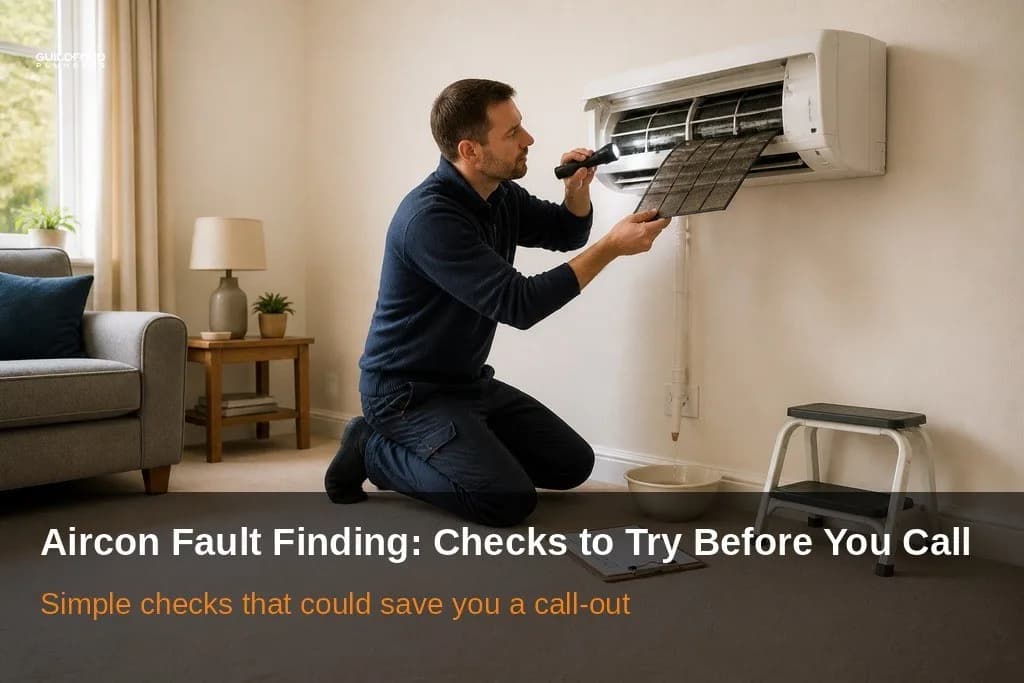
When your air conditioning unit stops performing as it should, the instinct to pick up the phone straight away is completely understandable. Working through a basic air conditioner troubleshooting guide first, however, can save you time, money, and the frustration of waiting for a call-out that may not be necessary. Many of the most common air conditioner problems have straightforward causes that homeowners in Guildford and across Surrey can identify and sometimes resolve on their own. This guide walks you through what to check, what to rule out, and when it genuinely is time to hand things over to a qualified engineer.
One important caveat before you start: not every fault is safe or legal to tackle without professional help. Some repairs require a Gas Safe Registered or F-Gas certified engineer, and attempting them without the right qualifications could void your warranty, create a safety hazard, or breach UK regulations. This guide draws a clear line between what is reasonable to check yourself and what should always be left to a trained professional.
Why Is My Air Conditioning Unit Not Working Properly?
Air conditioning faults rarely appear out of nowhere. In most cases, performance issues develop gradually as components wear, filters accumulate debris, or small installation imperfections build up over time. Research from the U.S. Department of Energy found that more than 65% of residential HVAC systems have been improperly installed and are running below their potential, often due to problems with airflow, refrigerant charge, or air distribution. What feels like a sudden breakdown may actually be the end result of a long-running underlying issue.
Early warning signs, such as rooms taking longer to cool, unusual odours when the unit runs, or a slight rise in energy bills, are easy to dismiss. Many homeowners in Guildford notice these signs but wait until the unit stops working entirely before investigating. Knowing the common causes of underperformance helps you catch problems earlier and describe them more accurately when you do speak to an engineer.

What to Check First: A Logical Order
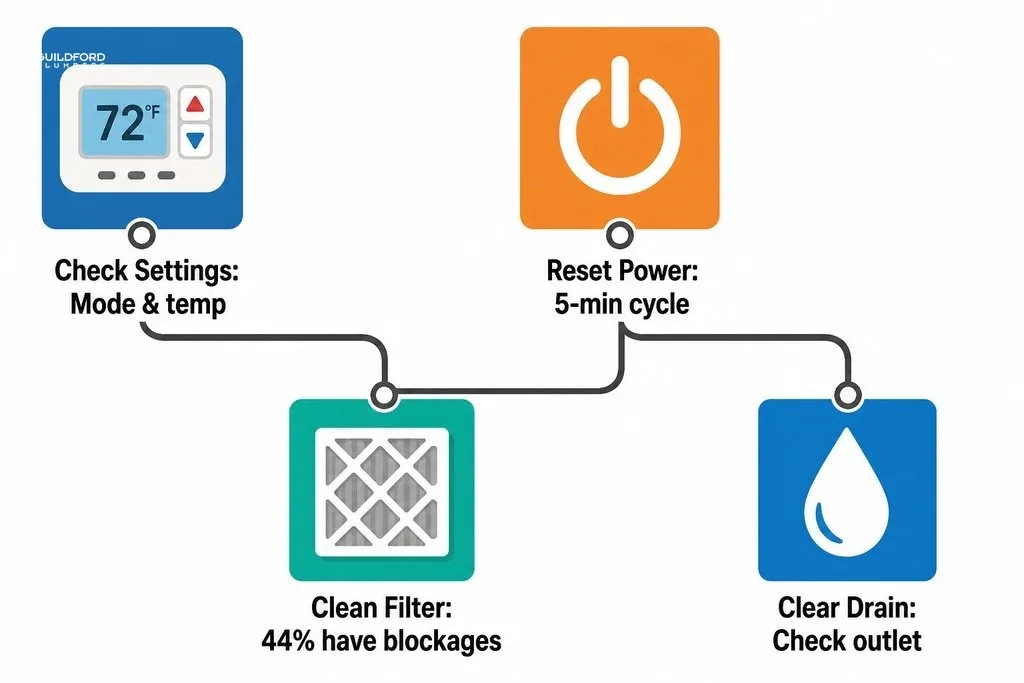
Before booking a call-out, work through these four checks in sequence:
- Thermostat and mode settings — confirm the unit is set to cooling mode and the target temperature is lower than the room temperature.
- Filters and airflow — remove and inspect the filter; clean or replace it if blocked.
- Power and circuit breaker — reset the unit and check the fuse board for a tripped breaker.
- Condensate drain — look for visible blockages or standing water at the drain outlet.
If none of these resolve the issue, the fault is likely to require a qualified engineer.
Your Pre-Call Cooling Problem Checklist
Working through AC checks in a logical order rules out the simplest causes first, saving time for both you and any engineer you eventually contact. The sections below cover the most frequent sources of performance problems in residential air conditioning systems.
Thermostat and Mode Settings
Control settings are consistently the first thing engineers advise checking. A unit left in heating mode, fan-only mode, or set to a temperature higher than the room will appear faulty when it is actually behaving exactly as instructed. Research published in the Building Services Engineering Research and Technology journal found that 55% of air handling units experienced supply air temperature setpoint faults at some point, many of which traced back to control or scheduling issues rather than mechanical failure.
Check that your unit is set to cooling mode, that the target temperature is lower than the current room temperature, and that no timer or scheduling programme is overriding your manual settings. If you use a smart controller or app, confirm that the app settings and the unit's own panel are not in conflict.
Filters and Airflow
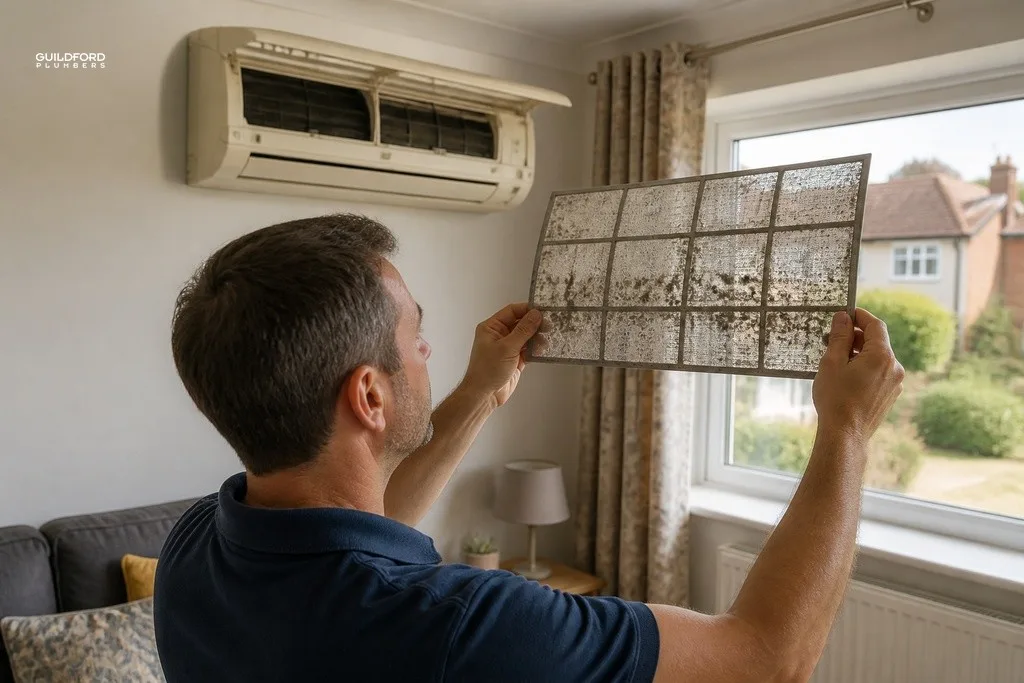
Dirty or blocked filters are among the most commonly cited causes of reduced cooling efficiency. A clogged filter forces the unit to work harder while moving less air, reducing performance, raising energy consumption, and potentially causing the system to overheat or freeze. A field study of 4,168 air conditioners conducted by the National Renewable Energy Laboratory (NREL) found that 44% of units had improper airflow, making this one of the most widespread faults in residential systems.
Switch the unit off, locate the filter panel (usually on the front or underside of the indoor unit), and slide the filter out carefully. Hold it up to a light source. If you cannot see light through it clearly, it needs cleaning or replacing. Most filters can be gently vacuumed or rinsed with cool water and left to dry fully before reinsertion. While the panel is open, also check that nothing is blocking the vents or grilles on either the indoor unit or the external condenser.
Common Air Conditioner Faults in Guildford: What the Symptoms Mean
Recognising what a symptom is likely to indicate helps you decide whether you can address it yourself or whether a professional is needed. During the warmer summer months in Surrey, when units are working at full stretch, these faults become particularly common.
- Warm air from a running unit — often linked to a thermostat or mode issue, a blocked filter, or in more serious cases, low refrigerant.
- Rattling, clicking, or grinding noises — typically point to loose components, debris inside the unit, or mechanical wear that warrants an engineer's assessment.
- Water dripping from the indoor unit — frequently caused by a blocked condensate drain, though a frozen evaporator coil is also possible.
- Error codes on the display panel — the system flagging a specific internal fault; note the code before you call, as an engineer will ask for it.
| Symptom | Likely Cause | DIY Check Possible? |
|---|---|---|
| Warm air from a running unit | Incorrect mode or thermostat setting, blocked filter, or low refrigerant | Yes — check settings and filter first; refrigerant requires an engineer |
| Rattling, clicking, or grinding noises | Loose components, debris inside the unit, or mechanical wear | No — warrants an engineer's assessment |
| Water dripping from indoor unit | Blocked condensate drain or frozen evaporator coil | Partial — try clearing the drain outlet; call an engineer if it persists |
| Error code on display panel | Internal fault flagged by the system | Partial — note the code and try a full reset; call an engineer if it reappears |
Noting the symptom before you call helps any engineer diagnose the problem faster and arrive better prepared.
Basic AC Troubleshooting Steps You Can Safely Do Yourself
Resetting the Unit
A full reset clears temporary faults and allows the system to restart cleanly, resolving a surprising number of minor performance issues. To do this correctly:
- Switch the air conditioner off at the unit itself.
- Turn it off at the wall socket or isolator switch.
- Check the consumer unit (fuse board) to confirm the relevant circuit breaker has not tripped.
- Wait at least five minutes, then restore power and switch the unit back on.
Air conditioner electrical problems related to tripped breakers or loose connections at the isolator switch are worth ruling out at this stage, though any deeper electrical investigation should be left to a qualified electrician or engineer.
Checking the Condensate Drain
The condensate drain carries moisture away from the indoor unit. If it becomes blocked with algae, dust, or debris, water backs up and may trigger a fault or cause leakage. On many units, the drain outlet is accessible at the side or base of the indoor unit.
If you can see standing water or a visible blockage, carefully clearing the outlet with a soft cloth or a gentle flush of clean water is a reasonable first step. Do not use chemical cleaners or attempt to disassemble the drain housing. If the blockage does not clear easily, or if the problem recurs quickly, call a professional.
When Basic Aircon Fault Finding Is Not Enough
Some faults are clearly beyond what any homeowner should attempt to address. Stop and call an engineer when you encounter:
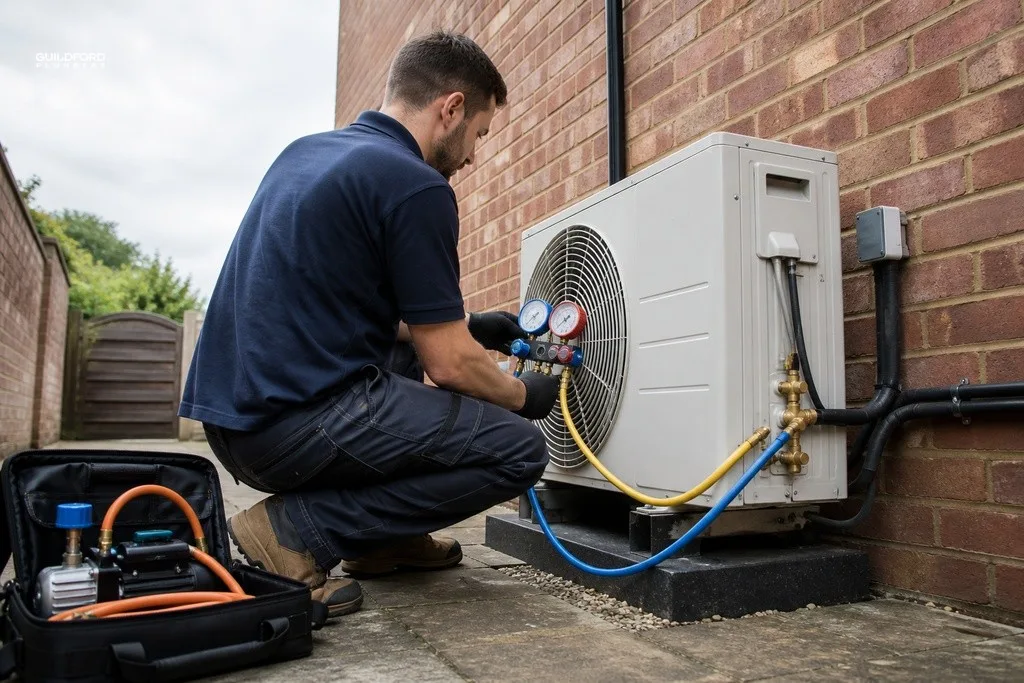
- Warm air despite correct settings and a clean filter — low or leaking refrigerant is a likely cause. Handling refrigerants legally requires an F-Gas certified engineer; attempting a top-up without certification is both illegal under UK law and potentially dangerous.
- Persistent air conditioner error codes that do not clear after a reset — these indicate an internal fault that needs professional diagnosis.
- Physical damage to the compressor, condenser coil, or internal wiring, which always requires a qualified engineer.
- Repeated circuit breaker trips, a burning smell, or the same error code after multiple resets — stop using the unit entirely until it has been assessed.
The field study referenced earlier found that 72% of the 4,168 units surveyed had improper refrigerant charge, underlining just how common this fault is and why it must always be handled by someone with the right training and certification. Continuing to run a unit with an unresolved electrical or refrigerant fault can cause further damage, increase repair costs, and in some cases create a genuine safety risk.
| Situation | Homeowner Action | Engineer Required? |
|---|---|---|
| Incorrect mode or thermostat setting | Adjust settings on the unit or app | No |
| Blocked or dirty filter | Remove, clean or replace the filter | No |
| Tripped circuit breaker | Reset at the consumer unit; do a full power cycle | Only if it trips repeatedly |
| Blocked condensate drain | Gently clear the outlet with a soft cloth or water flush | Only if blockage persists or recurs |
| Warm air despite correct settings and clean filter | Do not attempt further repair | Yes — likely low or leaking refrigerant (F-Gas certified engineer required) |
| Persistent error codes after reset | Note the code; stop resetting | Yes — internal fault requires professional diagnosis |
| Physical damage to compressor, coil, or wiring | Do not attempt repair | Yes — always |
| Burning smell or repeated breaker trips | Stop using the unit immediately | Yes — safety risk; do not use until assessed |
What to Have Ready Before You Call an Engineer
A prepared call makes the diagnostic process faster and more efficient. Before you ring, have the following to hand:
- Make and model of your unit, usually on a label on the indoor unit or in the original paperwork.
- Any error codes showing on the display, even if you do not know what they mean — the engineer will.
- How long the fault has been present and whether it appeared suddenly or gradually.
- Any recent changes around the time it started, such as a power cut, altered settings, or work carried out in your home.
- A plain description of the symptoms, for example: "the unit is running but blowing warm air and water is dripping from the indoor panel." This gives an engineer far more to work with than "it's not working properly."
How Guildford Plumbers Approaches Air Conditioning Diagnostics
At Guildford Plumbers, air conditioning diagnostics start with listening carefully. When homeowners in Guildford and the surrounding Surrey area, including Woking, Godalming, and Cranleigh, call with a cooling problem, the team takes the time to understand what the unit is doing, what has already been checked, and what the home's setup involves before any visit is booked. This honest, no-pressure approach means you will never be pushed towards a call-out you do not need, and free quotes are available so you can make an informed decision before any work begins.
With over 12 years of local experience and a team available 24 hours a day, 7 days a week, Guildford Plumbers is well placed to respond quickly when a fault turns out to be beyond the scope of a homeowner's checks. Whether the issue is a straightforward filter clean, a blocked condensate drain, a refrigerant fault requiring F-Gas certified work, or something more complex involving the electrical system, the team has the qualifications and local knowledge to diagnose it accurately and fix it properly first time. There is no call-out fee, and every job is carried out with the transparency and care that the Guildford community has come to expect. If your checks have not given you a clear answer, get in touch with the Guildford Plumbers team and let a qualified engineer take it from there.
Frequently Asked Questions About Air Conditioner Troubleshooting
Why is my air conditioner running but not cooling the room?
The most common causes are incorrect mode settings, a blocked filter, or low refrigerant. Check that the unit is set to cooling mode and the target temperature is below the room temperature, then inspect the filter. If both are fine, low or leaking refrigerant is the likely culprit, and you will need an F-Gas certified engineer to investigate.
Can I clean my air conditioning filter myself?
Yes, and it is one of the most useful maintenance tasks you can do. Switch the unit off, remove the filter panel, slide the filter out, then vacuum it gently or rinse it with cool water. Allow it to dry completely before putting it back. During periods of heavy use, aim to do this every few weeks.
What does it mean when my air conditioner displays an error code?
An error code means the unit has detected a specific internal fault. Note the exact code, then try a full reset: switch off at the unit, turn off at the isolator, wait five minutes, and restore power. If the same code reappears, contact a qualified engineer, who will be able to identify what it means for your make and model.
Is water dripping from my indoor unit always a serious fault?
Not always. It is most often caused by a blocked condensate drain, which is relatively straightforward to address. Try gently clearing the drain outlet with a soft cloth or a careful flush of clean water. If the dripping continues or the blockage returns quickly, call a professional, as a frozen evaporator coil may also be involved.
When is it illegal to repair an air conditioner yourself in the UK?
Handling refrigerants without an F-Gas certification is illegal under UK law, whether the system is domestic or commercial. This covers topping up refrigerant and repairing refrigerant leaks. Electrical work beyond basic checks, such as resetting a tripped breaker, should also only be carried out by a qualified electrician or engineer.
How do I reset my air conditioning unit properly?
Switch the unit off at its own controls, then turn it off at the wall socket or isolator switch. Check the consumer unit (fuse board) to confirm the circuit breaker has not tripped. Wait at least five minutes before restoring power and switching the unit back on. This full power cycle clears temporary faults and lets the system restart cleanly.